
Money Laundering Offences for Accountants: Penalties and Defences Under POCA 2002
Understand the money laundering offences accountants can commit under POCA 2002, including maximum penalties, reporting duties, and the defences available under UK law.

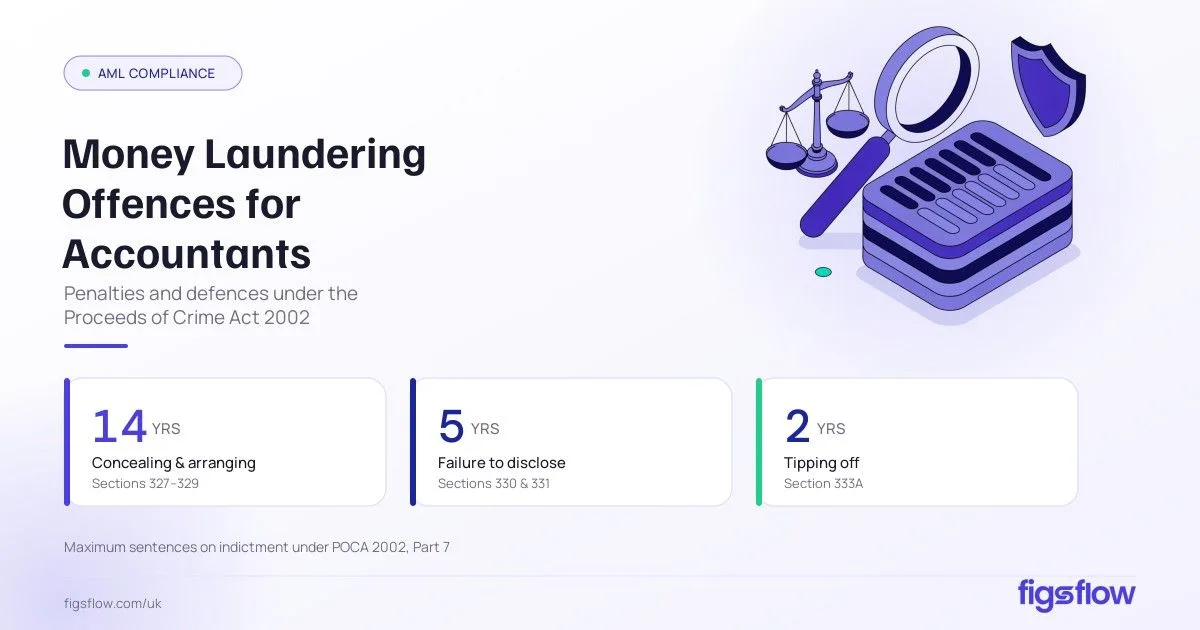
Concealing a client’s criminal property carries up to 14 years. Failing to report a suspicion carries five. Tipping off a client carries two. The Proceeds of Crime Act 2002 does not treat these as one offence with one penalty, a distinction that is easy to miss.
The gap matters because section 330, the provision that actually catches regulated sector professionals, does not require knowledge or suspicion of criminal property the way section 327 does. It requires only a failure to report what a reasonable person in their position would have suspected.
This article sets out each money laundering offence an accountant can commit under POCA 2002, the section number, the maximum penalty, and the defence that actually applies to it.
The Offences Accountants Can Commit
| Offence | Section | Maximum penalty | Who it applies to |
|---|---|---|---|
| Concealing, disguising, converting, transferring or removing criminal property | s.327 | 14 years and a fine on indictment, 6 months and the statutory maximum fine summarily | Anyone |
| Entering into or becoming concerned in an arrangement facilitating another person’s use of criminal property | s.328 | Same as s.327 | Anyone |
| Acquiring, using or possessing criminal property | s.329 | Same as s.327 | Anyone |
| Failing to disclose a suspicion, learned in the course of regulated sector business | s.330 | 5 years and a fine on indictment, 6 months and the statutory maximum summarily | Accountants, auditors, tax advisers and other regulated sector businesses |
| A nominated officer failing to pass on a disclosure to the NCA | s.331 | Same as s.330 | Money laundering reporting officers (MLROs) in the regulated sector |
| Disclosing that a report has been made, or that an investigation is underway | s.333A | 2 years and a fine on indictment, 3 months and a level 5 fine summarily | Regulated sector businesses |
| Making a disclosure or destroying documents likely to prejudice an investigation | s.342 | 5 years and a fine on indictment, 6 months and the statutory maximum summarily | Anyone |
Accountancy services, tax advice and statutory audit work provided by way of business are named directly in Schedule 9 to the Act as regulated sector business. That is the provision that pulls accountants into sections 330, 331 and 333A, on top of the general sections 327 to 329 and 342 that apply to anyone handling the proceeds of money laundering, regardless of sector.
Section 327: Concealing or Disguising Criminal Property
Section 327 carries the heaviest penalty in Part 7 of the Act: up to 14 years and an unlimited fine. It prohibits concealing, disguising, converting, transferring or removing criminal property from England and Wales, Scotland or Northern Ireland.
An accountant who restructures a client’s accounts, knowing or suspecting the underlying funds come from crime, with the effect of disguising their source, falls directly under this section. This sits separately from the failure to disclose duty under section 330. A firm can breach section 327 even where no report was ever expected of it, simply by acting on what it already knew.
Filing a suspicious activity report and obtaining appropriate consent under section 335 before acting is the statutory protection against this offence, provided the authorised disclosure and consent conditions in section 335 are actually met. The notice and moratorium periods that govern when consent is treated as given are set out in the defences section below. The firm’s suspicious activity report process exists precisely to create that protection.
Section 328: Entering an Arrangement
Section 328 carries the same 14-year maximum and covers entering into or becoming concerned in an arrangement that facilitates another person’s acquisition, retention, use or control of criminal property.
Accountants have been exposed to this section for structuring a transaction, not for handling the funds directly, where they know or suspect what the arrangement is actually achieving. Property transactions are the clearest example: a client overpays for a property to clean funds, or structures a deposit to obscure its source, and the professionals who help arrange the deal can be caught even without touching the money.
Section 329: Acquiring, Using or Possessing Criminal Property
Section 329 carries the same penalty band and covers acquiring, using or possessing criminal property.
Accepting fees that an accountant knows or suspects derive from crime can fall under this section, independent of any work done on the client’s own transactions. The offence attaches to the accountant’s own conduct in receiving the payment, not to anything the firm advised the client to do.
Section 329(2)(c) provides a defence where the property was acquired, used or possessed for adequate consideration. Section 329(3) defines inadequate consideration as consideration significantly less than the value of the property, and expressly excludes goods or services known or suspected to help someone commit criminal conduct from counting as consideration at all. Whether this defence applies depends on the property, the conduct and the consideration actually given in the specific case, so a fee charged at a normal commercial rate for genuine accountancy work is not automatically caught by this section just because the client’s underlying funds are suspect.
Failure to Disclose in the Regulated Sector (Section 330)
Section 330 carries a lower maximum, 5 years, but it is a key offence risk for accountants specifically, because it requires no intent to launder anything. It requires only a failure to report.
The offence has four elements. First, the accountant knows or suspects, or has reasonable grounds to know or suspect, that another person is engaged in money laundering. That third limb, reasonable grounds, is an objective test. It does not require the accountant to have actually suspected anything, only that a reasonable person with their information would have. Second, that knowledge or suspicion came from information received in the course of regulated sector business. Third, under section 330(3A), the accountant can identify the other person or the whereabouts of the laundered property, or believes, or could reasonably be expected to believe, that the information will or may help identify either. Fourth, the accountant fails to disclose it to a nominated officer or an authorised person as soon as practicable.
Section 330(14) defines a “relevant professional adviser” as an accountant, auditor or tax adviser belonging to a professional body that tests entry competence and enforces ethical standards, which places most UK practices directly inside this provision.
Defences exist. A reasonable excuse for not disclosing is a defence under section 330(6)(a). Information received in privileged circumstances, such as a client’s instructions given for the purpose of seeking legal advice, is protected under section 330(6)(b), subject to section 330(11) removing that protection where the communication furthers a criminal purpose. A lack of required training given by the employer is a separate defence under section 330(7)(b). The court must also consider, under section 330(8), whether the accountant followed Treasury approved guidance current at the time.
The Nominated Officer’s Duty (Section 331)
Section 331 mirrors section 330, but it attaches to the firm’s nominated officer, its MLRO, rather than to the accountant who first raised the concern. The same 5 year maximum applies.
The offence arises where the nominated officer receives an internal disclosure under section 330, knows or suspects, or has reasonable grounds for knowing or suspecting, money laundering as a result, can identify the other person or the laundered property, or believes, or could reasonably be expected to believe, that the information will or may help identify either, under section 331(3A), and fails to pass that disclosure on to the National Crime Agency as soon as practicable. The same reasonable excuse defence under section 331(6) applies.
Appointing an MLRO does not transfer risk away from the firm. It creates a second point of personal criminal liability inside it, which is why the role needs real authority to act on what it is told, not just a title.
Tipping Off (Section 333A)
Section 333A carries a maximum of 2 years on indictment and 3 months summarily. Several AML guides for accountants still cite a 5 year maximum for tipping off. That figure belongs to the original section 333 offence. The current provision sits in section 333A, and it carries a materially lower sentence.
The offence has two limbs, both of which apply only where the information came to the accountant through regulated sector business. That restriction makes this a direct extension of the accountant’s professional duties rather than a general dishonesty offence. Sections 333B to 333D set out permitted disclosure exceptions to both limbs, so not every disclosure linked to a report or investigation is automatically prohibited. The exact scope of those exceptions needs checking against the current text before relying on them in a specific case.
Disclosing That a Report Has Been Made (Section 333A(1))
Section 333A(1) prohibits disclosing that a report has been made under Part 7 of the Act, where the disclosure is likely to prejudice any resulting investigation.
Disclosing That an Investigation Is Underway (Section 333A(3))
Section 333A(3) prohibits disclosing that an investigation into alleged money laundering is being carried out or contemplated, on the same prejudice test.
The practical boundary, what counts as normal client communication against what crosses into tipping off under either limb, is the harder judgment call in this offence than the statute itself.
Prejudicing an Investigation (Section 342)
Section 342 carries a 5-year maximum and applies where a person knows or suspects that an appropriate officer is acting, or proposing to act, in connection with a money laundering or related investigation. On that precondition, it covers two separate acts: making a disclosure likely to prejudice the investigation, and falsifying, concealing, destroying or otherwise disposing of relevant documents, or causing or permitting someone else to do so. Unlike section 333A, it is not limited to the regulated sector, and the Act sets out specific exceptions to the disclosure limb beyond the professional legal adviser defence below.
A professional legal adviser, meaning a lawyer, has a specific defence under section 342(4) where the disclosure was made to a client in connection with legal advice, or to any person in connection with actual or contemplated legal proceedings. Section 342(5) removes that defence where the disclosure was made with the intention of furthering a criminal purpose. This defence belongs to the professional legal adviser specifically. It does not extend to accountants or tax advisers simply because they count as relevant professional advisers elsewhere in the Act.
Defences Available to Accountants
Five defences recur across these offences, and a firm’s AML file should be built to evidence each one it relies on.
Appropriate consent is the defence to sections 327 to 329, and it runs through two different routes depending on who the disclosure is made to. Under section 335, a person who makes an authorised disclosure directly to a constable or customs officer is treated as having consent if no refusal arrives within seven working days, or once a 31-day moratorium period has run its course after a refusal. Under section 336, a nominated officer relaying an internal disclosure to an NCA authorised person follows the same seven-day notice period and 31 day moratorium but commits a separate offence under section 336(5) if they give consent to a prohibited act without one of these conditions actually being met.
Reasonable excuse under section 330(6)(a) and section 331(6) is the general defence to both failure to disclose offences, though the Act does not define what counts as reasonable, which is why the basis for relying on it needs to be documented at the time, not reconstructed afterward.
Privileged circumstances under section 330(6)(b) and (10) protect information received for the purpose of giving legal advice or in connection with legal proceedings, extended to support staff assisting a relevant professional adviser under section 330(7B).
Lack of required training under section 330(7)(b) protects an accountant who did not know or suspect money laundering where the firm failed to provide the training it was required to give.
The professional legal adviser defence under section 342(4) applies specifically to prejudicing an investigation, not to tipping off, is limited to lawyers rather than accountants or tax advisers generally and does not survive a criminal purpose under section 342(5).
Where Accountants Get This Wrong
A frequent failure is treating the section 330 standard as subjective. It is not. “Reasonable grounds to suspect” is judged against what a reasonable professional would have concluded from the information available, regardless of what the individual accountant actually believed. A firm that documents its red flag monitoring and training only after a problem surfaces is relying on weaker evidence to support a reasonable excuse defence than if the record had been made at the time.
Section 330(7E), a new defence covering information obtained only through an eligibility verification notice under the Social Security Administration Act 1992, was inserted into the Act on 2 February 2026. Firms still working from pre-2026 AML training materials will not know it exists.
Technology does not remove the judgment required under section 330, but it can close the documentation gap that undermines a reasonable excuse defence after the fact, building the evidence trail as monitoring happens rather than reconstructing one during an investigation.
Money laundering is not the only risk area accountants in the regulated sector have to manage. Firms handling clients exposed to sanctioned states or dual use trade carry separate counter proliferation financing risk assessment and control obligations under the Money Laundering Regulations 2017, alongside the POCA reporting duties covered here.
Conclusion
Three bands of offence, three different tests, one regulated sector duty that catches accountants specifically: report what you had reasonable grounds to suspect, as soon as practicable, and document why you acted or didn’t. Get the test wrong and the firm’s exposure sits with the individual who missed it and the MLRO who failed to escalate it, not just the client who caused it. Review your firm’s reasonable excuse and training records against sections 330 and 331 before the next file closes, not after.
Additional Resources
- Proceeds of Crime Act 2002, Part 7 — the full statutory text of the offences covered above.
- HMRC Economic Crime Supervision Handbook, ECSH23000 — HMRC’s own summary of the Part 7 offences for supervised businesses.
- What Is Anti-Money Laundering in the UK — the wider AML framework these offences sit inside.
- AML Acronyms and Definitions — plain English definitions for MLRO, SAR, DAML and the other terms used throughout this article.
- Suspicious Activity Report in Anti-Money Laundering — the disclosure process referred to in sections 330 and 331.
- Tipping Off in Anti-Money Laundering — where normal client communication ends and a section 333A disclosure begins.