
The Day Companies House Stopped Accepting Unverified Directors
A composite evening, not a case file
 Swikriti ThakuriSep 30, 2026Updated Sep 30, 2026
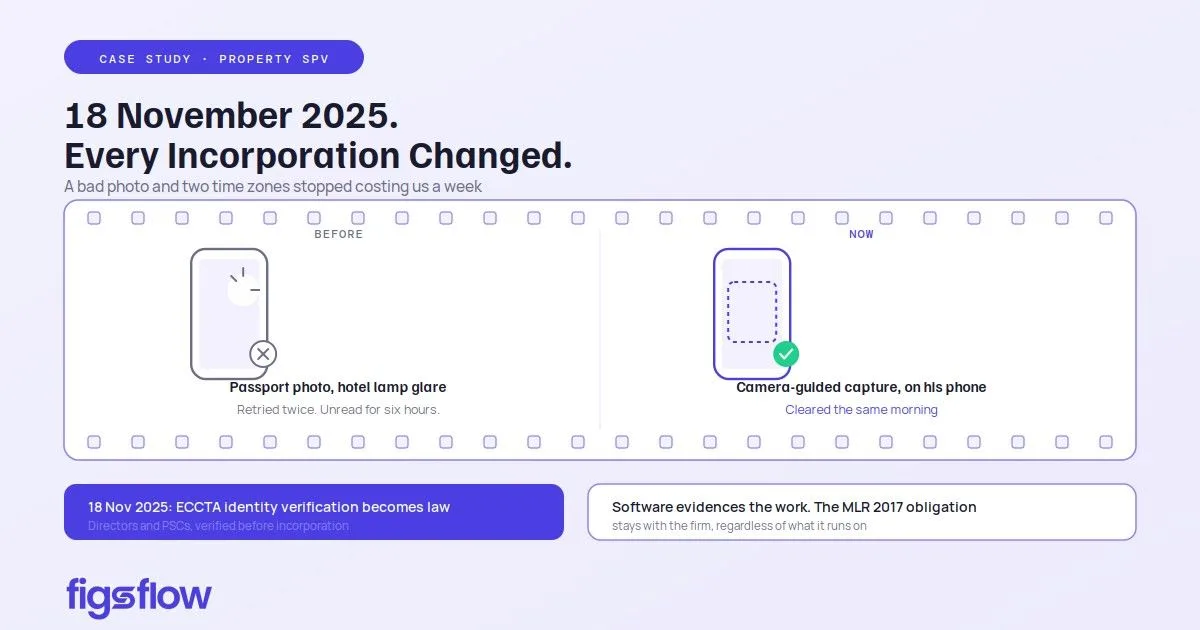
On 18 November 2025, identity verification for company directors and persons with significant control became a legal requirement under the Economic Crime and Corporate Transparency Act 2023. For most of the country, that was a news story. For a property SPV formation business, it was Tuesday's workload rewritten overnight: every incorporation now carried a compliance step that hadn't existed the week before.
A composite evening, not a case file
It's 11 at night, somewhere several time zones from London. A director forming his second SPV with us is trying to photograph his passport against a hotel desk lamp, gets the glare wrong twice, and emails it anyway because it's late and he wants this done. Someone on our side picks it up the next morning, can't quite make out the expiry date, and replies asking him to try again. But by now, it's his working day too, and the email sits unread for six hours. What should have been same-day identity verification stretches into most of a week, for no reason except a bad photo and two time zones that don't overlap.
What changed
That process doesn't exist anymore. We moved onboarding onto FigsFlow's AML and client due diligence module, and identity verification now runs on the client's own phone, inside the same flow where he chooses his package (this includes camera-guided capture, not a photo taken under a hotel lamp and emailed on faith). PEP and sanctions screening runs automatically behind it. Because this is a Non-UK Resident formation, FigsFlow's risk rules route it straight to enhanced due diligence and a named reviewer, rather than waiting for someone to notice it should have been flagged. Further, every decision carries a timestamp and a reason, so the record answers the question before anyone has to ask it.
What FigsFlow doesn't do
We're precise about what that record is, and to be fair, so is FigsFlow's own product literature: software evidences the work, it doesn't carry the obligation. The Money Laundering Regulations 2017 put that obligation on us, not on any piece of software, and it stays there regardless of what we run it on. What's changed is how fast we can meet it, and how little of that speed depends on a client's phone signal or a reviewer's inbox habits.
The week now, in the numbers
Standard-risk formations clearing the same morning rather than over several days of back-and-forth. Non-UK Resident applications reaching enhanced due diligence automatically, rather than being caught later by whoever happens to be reviewing the queue. Documents chased a second time by email: rare enough now that when it happens, someone asks why.
Run your firm on one platform
Proposals, engagement letters, pricing and AML — built for ACCA, ICAEW, ATT, CIOT, AAT and CIMA firms.