
The Reports We Actually Open, and What One of Them Found
The useful thing about reporting that reads off the same record the work was delivered against is not that it looks better. It is that it arrives while there is still something you can do about it.
 Swikriti ThakuriSep 30, 2026Updated Sep 30, 2026
FigsFlow changed more than how we run individual jobs. It changed what we can see while the practice is running. Most practices discover what is wrong with them once a year, in the worst month, from a spreadsheet somebody rebuilds each quarter and nobody entirely believes. We were no exception.
The useful thing about reporting that reads off the same record the work was delivered against is not that it looks better. It is that it arrives while there is still something you can do about it.
How We Used to Find Out
Time went against codes like Admin, miscellaneous. The agreed fee lived in a letter. Reconciling the two was an annual exercise conducted in a bad mood, usually in February, by which point every decision it might have informed had already been taken.
The Report That Changed a Decision
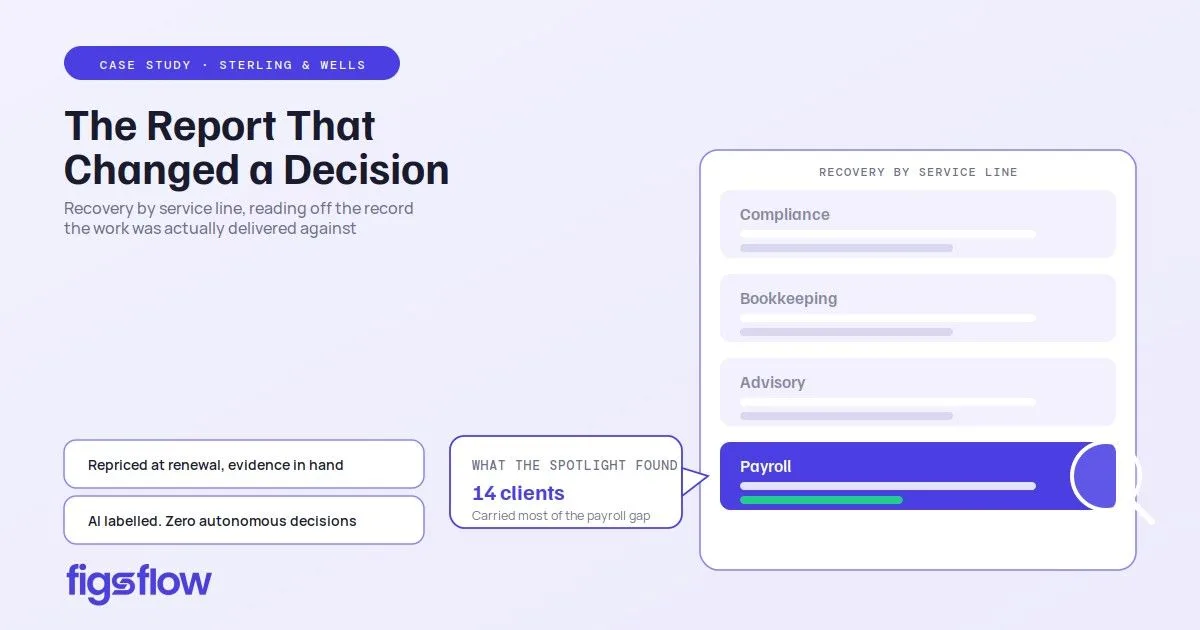
Recovery by service line told us that our payroll work was recovering considerably less than anything else we do. Nobody had voiced that as a suspicion, because payroll is the service that generates the fewest complaints and therefore attracts the least attention. It was being carried by the compliance work, and 14 clients accounted for most of it.
That was visible only because recorded time and agreed fee sit on the same record. We repriced at renewal with the evidence in front of us, rather than negotiating from instinct and then feeling faintly guilty about the number we had arrived at.
Four Numbers, and the One That Changed Behaviour
The practice dashboard carries realisation, work in progress age, debtor days and budget against actual.
The one that changed how people work is budget against actual, because it shows a job going over while the job is still running rather than at the point of billing it. A job carrying unbilled time is flagged before it becomes a write-off, which is an entirely different conversation from discovering the write-off afterwards.
On the Assistant
A great deal of nonsense is written about this, so we will be exact.
The assistant reads what is already on our own records, being deals, jobs, deadlines, requests and timesheets, and answers the question a partner asks on a Monday morning – which clients need attention, what is being held, and what fees sit behind the work that is blocked. It triages email, summarises long client threads and drafts correspondence.
It does not decide anything. AML scope and risk ratings are determined from coded rules rather than inferred by a model, and the decision belongs to our MLRO. Every AI-assisted action is labelled as such, and every draft is edited or discarded by a person before it goes anywhere.
That was specified deliberately. An assistant quietly exercising judgement is a liability dressed as a convenience, and the liability stays with the firm either way.
Conclusion
Honest reporting is not a pleasant experience at the outset. The figures were not flattering and there was nowhere left for them to sit unexamined. That is the point of them, and a firm that wants reassurance rather than information should not turn them on.
It also only answers questions about what is on the record. It cannot tell you about the thing nobody entered.