
How FigsFlow Changed Our VAT Service Delivery: One Quarter Seen from Both Sides
At Sterling & Wells, FigsFlow changed what happened between the moment we needed information from a client and the moment the completed return reached them for approval. To show what that change actually looks like in practice, we are following one VAT quarter from both sides: first as the client experienced it, and th
 Swikriti ThakuriSep 30, 2026Updated Sep 30, 2026
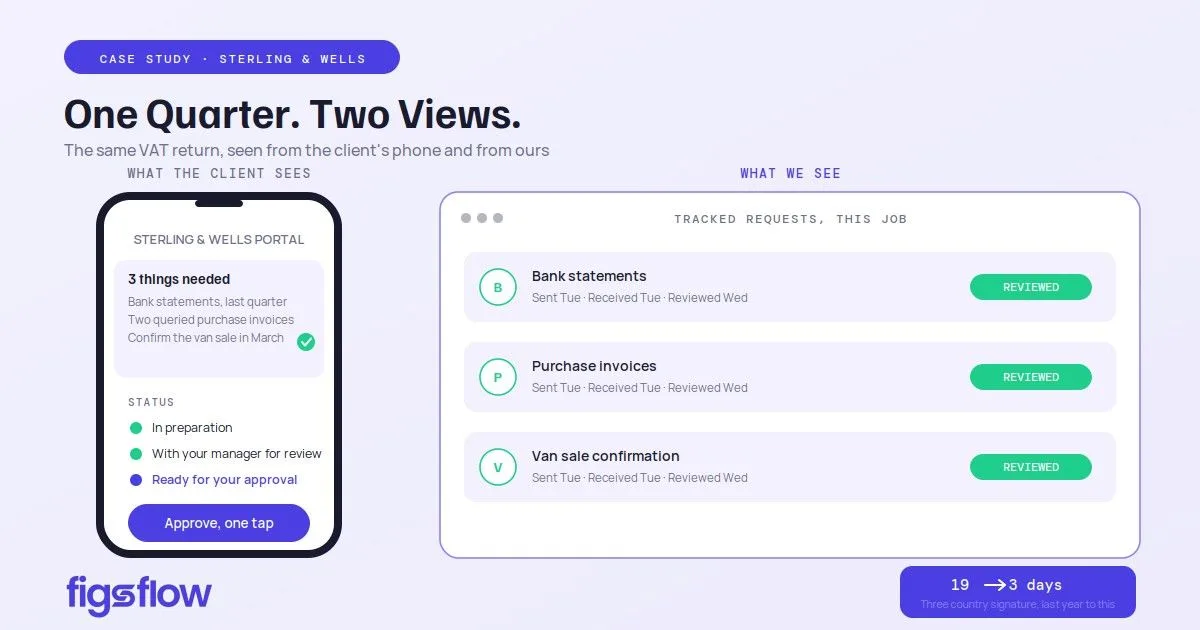
A quarter of VAT compliance work looks entirely different depending on which end of it you are standing at.
At Sterling & Wells, FigsFlow changed what happened between the moment we needed information from a client and the moment the completed return reached them for approval. To show what that change actually looks like in practice, we are following one VAT quarter from both sides: first as the client experienced it, and then as we did.
The important part is the gap between those two accounts. Before FigsFlow, much of the work required emails, reminders, attachments, manual filing and people knowing where things stood. The client experienced that as waiting and uncertainty. We experienced it as administration and follow-up.
The workflow is different now.
What the Client Sees
A notification arrives on Tuesday morning saying three things are needed. He opens it on his phone without creating an account and without remembering a password, because portal access is tokenised and the link simply works. The list says last quarter's bank statements, the two purchase invoices over £500 we queried, and confirmation that the van was sold in March. He photographs the statements with the client app, which crops the edges for him.
Three items dealt with in about four minutes. That sounds like a small improvement until you compare it with the old service experience. Previously, the request could arrive as an email containing several questions, perhaps with an attachment or two, followed by another email when something was missing. The client had to work out what was still outstanding and where to send it.
FigsFlow changed the request itself into part of the service workflow. The client is not being asked to understand how we manage VAT work internally. He is simply being told what we need and given a way to provide it.
Nine days later, the portal tells him the return is in preparation. Four days after that, it is with his manager for review. Two days after that, it is ready for his approval, and he approves it with one tap.
The client therefore sees a sequence rather than a black box. He knows what we have asked for, what we are doing, when the return is ready and when we need him to act.
What We See
The same three items appear to us as tracked requests, each moving from sent to received to reviewed. That means the status is visible to anyone in the firm rather than sitting in the mailbox of whoever happened to send the request.
Before FigsFlow, a request could effectively belong to the person who sent the email. If that person was away, someone else might have to search through messages to establish what had been requested, whether the client had replied and whether the documents had been reviewed.
Now the request has a status independent of the individual who created it. That visibility is the entire reason the second reminder now goes out because the client has not replied, rather than because nobody could tell whether he had.
When the statements arrive, they file to the client record in our own SharePoint, named properly, against the job they belong to, without anyone dragging anything anywhere.
The client sees a simple request. We see a controlled workflow. That is what changed our service delivery.
The Emails that Stopped Arriving
The measurable change was in what stopped coming in.
Inbound messages asking for an update used to be a steady background load, and almost all of them existed because the client genuinely had no way of knowing.
Where is the return? Have you received the documents? Has someone reviewed it? When will it be ready? Those questions have largely gone because the client can see the answer without having to ask for it.
The old workflow made the client dependent on us for information about the workflow. The FigsFlow workflow exposes the relevant status to the client, so the information does not need to be recreated by a member of staff every time someone asks for it.
Signatures Across Three Countries
The same change is even more obvious when a VAT engagement is part of a wider engagement requiring multiple signatures.
A group engagement needing three signatures in three countries took us 19 days last year. Nobody objected to anything. A PDF went out by email, one person printed and scanned it upside down, one replied from a phone asking which page, and one did not see it for a week.
The delay was not caused by a difficult client or a difficult engagement. The process itself created opportunities for delay.
The same structure signed in three days this year, two of which were a weekend.
The difference is not simply that electronic signatures are faster than paper. FigsFlow keeps the signing process attached to the engagement and records the progress of each signatory. The audit trail records the IP address, device and timestamp against each signatory, which is the part that matters if the engagement is ever questioned.
For the client, the change is simple – open, review and sign. For us, the change is that we no longer have to manage three separate physical or emailed copies and reconstruct afterwards who signed what and when. Again, the client sees a simpler service. We see a workflow that is easier to control.
Conclusion
Service delivery is not only the technical work performed for a client. It also includes how the client supplies information, how they know what is happening, how they approve work and how quickly they can get an answer when they need one.
Before FigsFlow, those parts of the service depended heavily on email and on individual members of the team keeping track of what was happening. After FigsFlow, more of that experience is built into the workflow.
Run your firm on one platform
Proposals, engagement letters, pricing and AML — built for ACCA, ICAEW, ATT, CIOT, AAT and CIMA firms.