
How UK Property Accountants Responded to an HMRC Enquiry in Half a Day Using FigsFlow's Audit Trail
Under our old stack, this is the enquiry that consumes a week of our time and involves hunting Outlook for the email chain, finding the version of the analysis actually filed rather than the earlier drafts, matching dates against completion statements, and hoping the client documents in the folder are the ones we relie
 Swikriti ThakuriSep 30, 2026Updated Sep 30, 2026
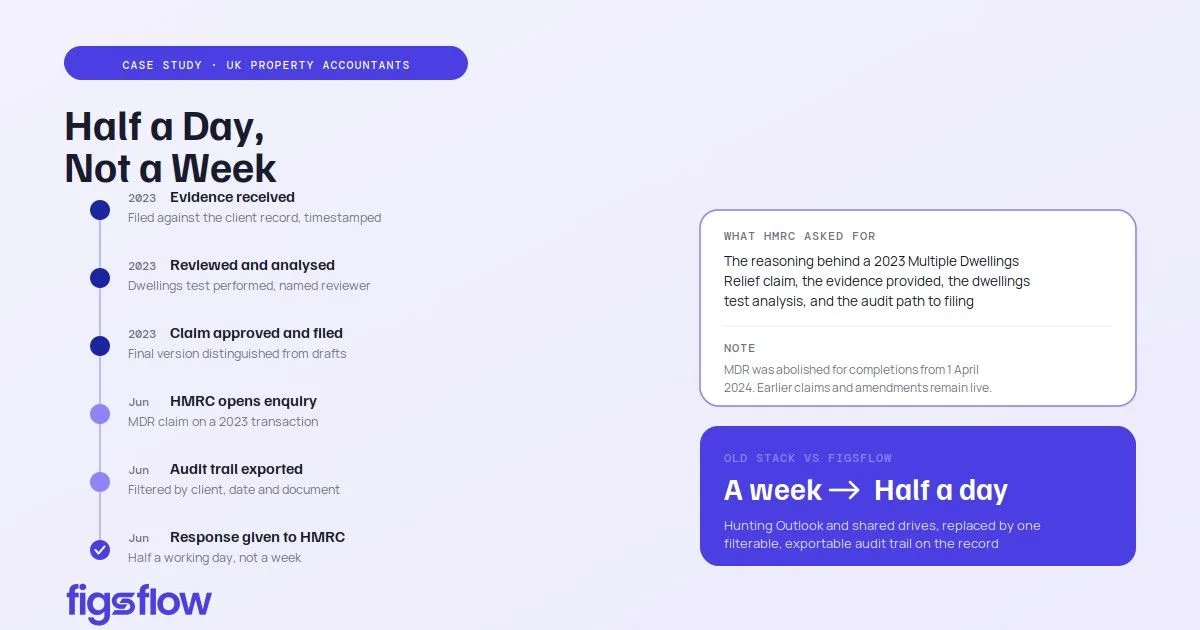
In June, HMRC opened an enquiry into a Multiple Dwellings Relief claim we had filed in 2023 (MDR was abolished by F(No.2)A 2024 for transactions completed on or after 1 April 2024, but earlier claims and amendments remain live). HMRC wanted the reasoning behind the claim at the time, the evidence the client had provided, our analysis of the dwellings test, and the audit path from acquisition through to filing.
Under our old stack, this is the enquiry that consumes a week of our time and involves hunting Outlook for the email chain, finding the version of the analysis actually filed rather than the earlier drafts, matching dates against completion statements, and hoping the client documents in the folder are the ones we relied on rather than a later set that arrived after filing.
FigsFlow allowed us to complete all those tasks in half a working day.
How FigsFlow Made Our Records More Efficient
- Audit Trail and Evidence - This was the biggest difference. Every document, review, action and approval sits against the client record with a timestamp and named user. We could see when the MDR evidence was received, who reviewed it, which analysis was performed, which version was approved and what was ultimately filed. The audit trail is filterable and exportable, so we could pull together the evidence HMRC had asked for without searching across separate systems.
- Documents and Version History - The enquiry specifically asked for the evidence and analysis relied on when the 2023 claim was made. FigsFlow let us distinguish the working material from the version that had actually been approved and filed. That meant we were not relying on filenames, email timestamps or someone's memory to establish which document was the final one.
- Client Communications and Information Requests - We could trace the requests that produced the evidence back to the client record rather than searching Outlook for an email chain. That gave us the context around each document, context like what we had asked for, what the client supplied and what our team did with it. It also helped demonstrate that the evidence existed before the claim was filed rather than being assembled retrospectively for the enquiry.
- AML, CDD and Risk Records - These were not the reason for the MDR enquiry, but they mattered to the integrity of the client file. Risk ratings are determined from coded rules and reviewed by our MLRO on a risk-based cadence. For higher-risk clients, enhanced due diligence, source-of-funds information, PEP and sanctions screening and ongoing monitoring are evidenced on the record. We did not have to reconstruct the compliance history separately from the tax file.
- Client and Entity Records - The same principle applies to the wider property engagement. Companies House information, director and PSC identity-verification status and other client-level records are attached to the relevant entity rather than sitting in separate spreadsheets. That gives the reviewer a consistent record of who the client was and which entities were involved when the work was carried out.
- Statutory Deadlines and Filing History - FigsFlow keeps the client’s obligations and workflow dates against the record, including self-assessment, VAT, MTD quarters, ATED, the Non-Resident Landlord Scheme and Companies House deadlines. This gave us the chronology around the engagement instead of forcing us to reconstruct dates from calendar entries and spreadsheets.
- MTD for Income Tax - For clients now within MTD ITSA, FigsFlow creates the quarterly workflow, tracks the client's outstanding information and keeps the supporting evidence against the record. The actual HMRC submissions need to be made through a separate HMRC-recognised MTD software. FigsFlow is not HMRC-recognised compatible software and does not file to HMRC.
The result was that the enquiry stopped being a document-reconstruction exercise. We could follow the audit trail from the original evidence through our review and analysis to the filed claim, assemble the relevant records and give the manager a coherent response in half a day rather than spending the week searching for it.
Conclusion
If you have ever spent a week reconstructing an audit trail from Outlook and shared drives, if your AML file gaps are things you find in internal audits rather than things you never had, if you cannot say with certainty that every one of your active directors is currently evidenced for Companies House IDV, and if the arrival of MTD ITSA is adding cadence obligations to a compliance calendar that is already full, FigsFlow is designed for exactly what you are describing.