
The Service Line We Repriced from 68% to 91% Realisation Using FigsFlow's Reporting Module
Most of the results confirmed what we expected. Accounts and tax were at 94% realisation. VAT and bookkeeping were at 91%. Payroll was at 72%, which we accepted as a deliberate loss-leader for clients taking other services from us.
 Swikriti ThakuriSep 30, 2026Updated Sep 30, 2026
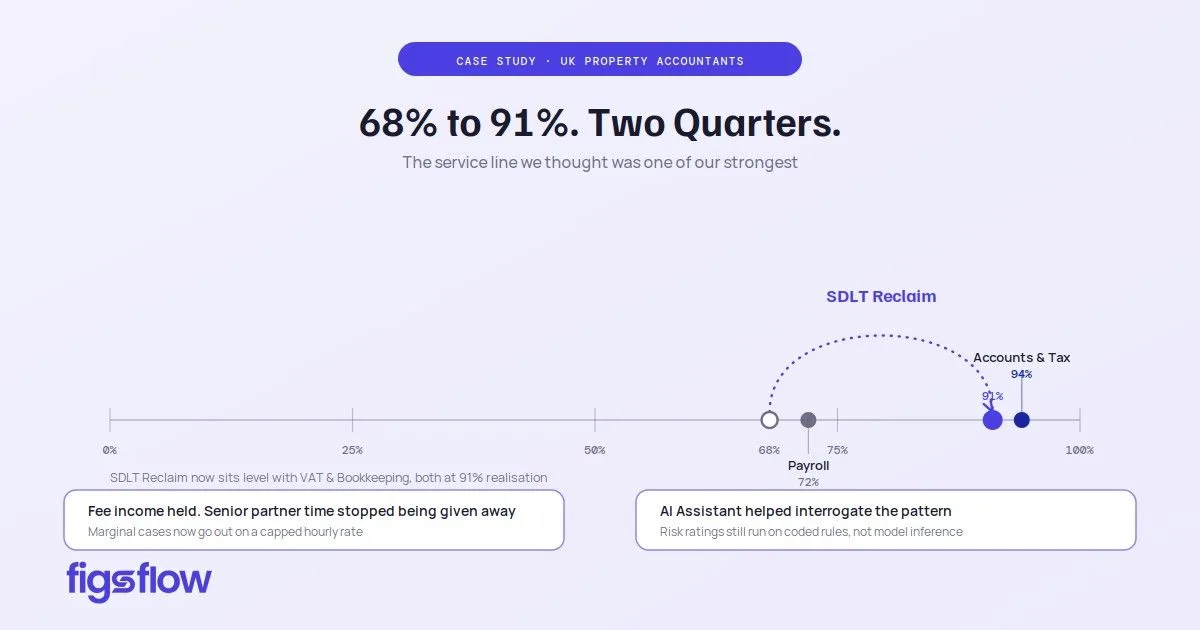
Twelve months after moving the practice onto FigsFlow, we finally had enough consistent data to see which service lines were actually making money. The reporting module calculated fee realisation against time recorded by service, client, manager and quarter, using the same records our teams worked from rather than numbers reconciled from four different systems at month-end.
Most of the results confirmed what we expected. Accounts and tax were at 94% realisation. VAT and bookkeeping were at 91%. Payroll was at 72%, which we accepted as a deliberate loss-leader for clients taking other services from us.
Then we saw one service line at 68% realisation.
That was not what we expected. We knew the fees we charged and the hours our teams recorded, but we had never been able to isolate the gap properly. FigsFlow's reporting module showed us where the realisation was falling. Its AI Assistant helped us interrogate the underlying data and identify the patterns behind it. That gave us enough evidence to stop treating the problem as a pricing hunch and work out what actually needed to change.
How FigsFlow Helps Us Make Informed Decisions
- Reporting and Analytics - Realisation, WIP by age, recovery rate, budget vs actual, and pipeline weighted by stage — all per client, per job, per service line, per manager. Every chart readable in greyscale, every figure available as a table. Nothing rebuilt in Excel, because it does not need to be.
- Practice Dashboard - Fees won, work in progress, realisation and what is held at due diligence, all in one screen.
- Weighted Pipeline - Enquiries priced from the same rules as the proposal, so pipeline value is not somebody’s optimism.
- AI Assistant - Reads what is already on the record — deals, jobs, deadlines, requests, timesheets — and answers the questions a partner asks first thing on a Monday. Drafts, summarises and triages. Every AI-assisted action labelled. Risk ratings and AML scope are determined by coded rules, not model inference. Professional judgement is not delegated to the assistant.
What the Report Told Us, And What We Did About It
We had assumed our SDLT reclaim work was one of our stronger contributors. Technical work, we are good at it, and the fees looked healthy on paper.
What the FigsFlow report actually showed was that once we counted the enquiry-defence time we absorbed on the subset of claims where HMRC pushed back, and once we counted the senior partner time spent on marginal cases, the service line was running at only 68% realisation.
We repriced it. Straightforward reclaims now go out at a fixed fee. Marginal cases go out on an hourly rate with a cap, and a written statement of what we consider marginal and why. Realisation on the service line moved from 68% to 91% inside two quarters. Fee income did not fall; the clients who wanted the marginal cases still wanted them. What fell was the amount of senior partner time we had been quietly gifting to work we were already being paid for.
Conclusion
If you cannot pull realisation by service line and manager off one screen, if your Monday morning starts with two hours of scanning Outlook and job boards, if you suspect a service line is underwater but cannot prove it, and if the fee leakage in your practice is something you discover in January rather than in March, FigsFlow gives you the evidence to make decisions on.