
Proposal and Engagement Letter Software, Tested in the Real World
Care home groups are the most awkward thing we price. Multiple entities, partial exemption on VAT, heavy payroll, CQC reporting support, and a fee that has historically been arrived at by a partner opening last year's proposal for a comparable client and adjusting it by feel.
 Swikriti ThakuriSep 30, 2026Updated Sep 30, 2026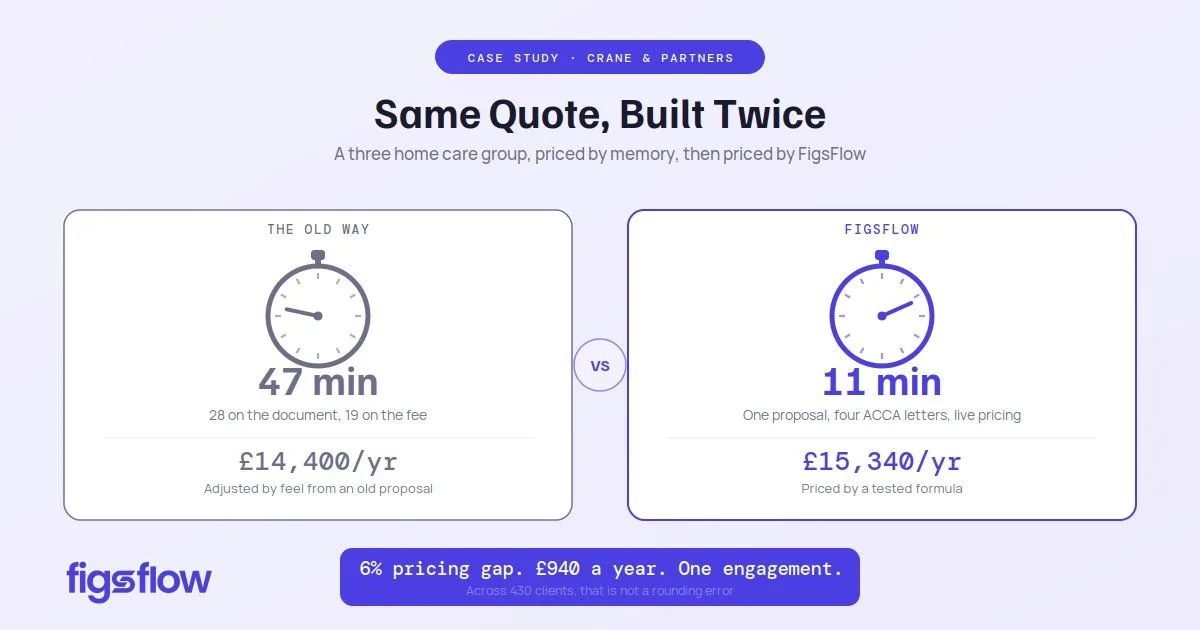
Win the Work at Crane & Partners — CRM and pipeline, onboarding, proposals, pricing and quoting, engagement letters. We took the hardest quote in our practice and built it twice. Here is every variable, every figure and both fees.
Care home groups are the most awkward thing we price. Multiple entities, partial exemption on VAT, heavy payroll, CQC reporting support, and a fee that has historically been arrived at by a partner opening last year's proposal for a comparable client and adjusting it by feel.
We wanted to know what that instinct was costing us. When a three-home group came to us, we priced it both ways and timed both.
The client
Anonymised, but the facts are as they were.
| Attribute | Detail |
|---|---|
| Structure | Three trading companies, one property holding company |
| Beds | 112 across three sites |
| Payroll | 140 staff, weekly and monthly runs |
| Transaction volume | Approximately 1,900 a month across the group |
| Record quality | Fair. Bank feeds connected, coding inconsistent |
| VAT | Partially exempt, welfare supplies |
| Backlog | Four months unreconciled on the holding company |
| Services wanted | Annual accounts and CT for four entities, bookkeeping, VAT, payroll, quarterly management accounts, company secretarial |
Method one: the way we have always done it
A partner opened the proposal we issued to a two-home group eighteen months earlier, worked through it, and adjusted.
- Time: 47 minutes. Twenty-eight on the Word document itself, nineteen on the fee.
- Fee arrived at: £14,400 per annum. His reasoning, written down afterwards at our request: the comparable group pays £11,200, this one is half again as large, and he did not want to frighten them at £16,800.
- Engagement letters: four separate Word documents, edited individually, because ACCA requires a letter per entity. Historically about 90 minutes, and the source of our most common error, which is one letter carrying a scope paragraph the others do not.
Method two: FigsFlow
We had already built a custom Care Home Group service. That setup cost is dealt with below. This is the quote itself.
Generate Proposal in the left sidebar. One entry point for a proposal, a letter of engagement, or both.
Client selected from FigsFlow Contacts as a group, all four entities on one engagement. FigsFlow generates a single proposal and issues separate letters of engagement to each entity, which is what ACCA requires and what we previously did by hand, four times, hoping the wording matched.
Services chosen from the 150-service library where they existed: Annual Accounts and Tax Returns, Bookkeeping and Finance Function, VAT Returns Review, Company Secretarial. Our custom Care Home Group service on top.
Variables entered into the configuration panel:
| Variable | Input |
|---|---|
| Beds | 112 |
| Homes | 3 |
| Entities | 4 |
| Payroll headcount | 140 |
| Monthly transaction volume | 1,900 |
| Quality of records | Fair |
| Bank accounts | 7 |
| VAT status | Partially exempt |
| Reporting frequency | Quarterly |
| CQC reporting support | Yes |
Calculated Prices panel output, updating live as each variable went in:
| Amount | |
|---|---|
| Net | £15,340 |
| VAT | £3,068 |
| Gross | £18,408 |
| Monthly toggle | £1,278.33 |
Catch-Up Fee toggled on for the four-month holding company backlog: £680, priced by the same formula rather than guessed at.
Associated Services ticked under Bookkeeping and Finance Function — Bank Reconciliation and Credit Control — each carrying its own pre-configured pricing into the running total.
General Discount of 5% applied for annual payment in advance.
Time: 11 minutes. Four engagement letters generated on the ACCA-aligned template, engagement start set to On Acceptance, no additional drafting time, because they build from the services already selected.
The gap
| By hand | FigsFlow | |
|---|---|---|
| Time to priced proposal | 47 minutes | 11 minutes |
| Time to four engagement letters | ~90 minutes | 0 |
| Net annual fee | £14,400 | £15,340 |
| Catch-up work | Not separately priced | £680 |
| Scope consistency across four letters | Manual | Generated |
£940 higher on the recurring fee, plus £680 of catch-up work we would have absorbed. The group accepted both figures without negotiating either.
That is the part worth sitting with. The partner's instinct was not wildly wrong. It was 6% wrong, in the client's favour, every year, on one engagement. Across a book of 430 clients, 6% is not a rounding error.
What building the formula cost us
One afternoon. Services in the sidebar, new service, name it, set tax rate, billing period and recurrence, then the Pricing Setup tab, which is a visual formula builder. We used:
- A tiered rate on bed count, so the per-bed fee steps down above 60 beds and again above 100
- A MIN floor, so no configuration can produce a fee below our break-even on the engagement
- An If Condition applying a premium where entities exceed two, because group consolidation is where the hours actually go
- A volume-based rate on monthly transactions, with a multiplier keyed to the record quality field
Preview Quote lets you test before saving. We ran ours against eleven existing care home fees and adjusted until it landed within 8% of what we would have quoted by judgement on each. That reconciliation is the step we would insist on for anyone building their own. A formula you have not tested against your own back book is a formula you will not trust at the moment you need it.
For the Service Description that appears in the proposal and the Service Schedule that goes into the letter, we prompted FigsFlow AI to draft both and then edited. A defensible scope paragraph used to be an hour of a manager's time. It was fifteen minutes of editing.
Our first attempt at this formula was wrong. We built it around turnover, our senior manager declined to stand behind the output, and she was right, because turnover does not drive cost in a care home. Beds and entities do. Three attempts before it was usable. Budget for that.
What this has done across the book
| Measure | Before | Now |
|---|---|---|
| Average first-year fee, new limited company | £1,180 | £1,460 |
| Conversion on qualified enquiries | 41% | 58% |
| Enquiry to signed engagement letter | ~3 weeks | 6 working days |
| Engagement letter turnaround once sent | 9 days | 2 days |
| New clients onboarded without extra admin headcount | — | 74 |
The Proposal and Engagement Letter Insights report explains most of the conversion move: proposals issued within 48 hours of the meeting convert at more than twice the rate of those issued after a week, and we can now issue within 48 hours.
We have also locked fee editing to manager level using the fee edit permission, so an associate can build and send a proposal but cannot override the calculator. That was not possible when the fee was a number typed into Word.