
How UK Property Accountants Runs a Property Tax Practice on FigsFlow
We are UK Property Accountants, the UK’s leading property accountants and tax specialists and we wrote this because a lot of firms our size and specialism ask us how we run our workflow. FigsFlow is the answer.
 Swikriti ThakuriSep 30, 2026Updated Sep 30, 2026
On any given morning in our office, someone on our team is reviewing an SDLT position on a 2023 transaction that has just come up for HMRC enquiry, someone is drafting an ATED return for a client whose only UK asset is a single £4 million residential property held through a Guernsey company, someone is chasing a 60-day CGT return for a non-resident individual who exchanged last month, and someone is walking a family office through the identity verification their offshore directors now need to complete with Companies House.
We are UK Property Accountants, the UK’s leading property accountants and tax specialists and we wrote this because a lot of firms our size and specialism ask us how we run our workflow. FigsFlow is the answer.
Why a Firm Like Ours Built Its Own Practice Management Software
For years, we ran on what most firms our size run on. A CRM that knew our clients. A separate proposal tool. A Word template folder for engagement letters. An AML platform with its own login. A jobs board a manager updated on Mondays. A statutory deadlines spreadsheet somebody had to nurse. Timesheets. Ledger software. Tax software. Payroll software. Everything spoke a slightly different language, and the connective tissue between them was our staff members and hundreds of internal emails a week.
Property tax cannot function off generic practice management software. For instance, a property group may involve an offshore trust, multiple UK residential SPVs, directors, shareholders and PSCs, with the same individuals and ownership relationships appearing across several entities. The compliance obligations can span SDLT, ATED, corporation tax, VAT, PAYE, NRL, IHT, ROE and Companies House, with different deadlines and filing requirements applying to different parts of the structure. A generic PMS may record each entity and its tasks, but it does not show how those entities, people, ownership interests and obligations connect. For a property tax practice, that relationship is not background information. It is the structure of the work itself.
That’s why we adopted FigsFlow, and we are very glad we did.
One Family Office, One Record, 13 SPVs
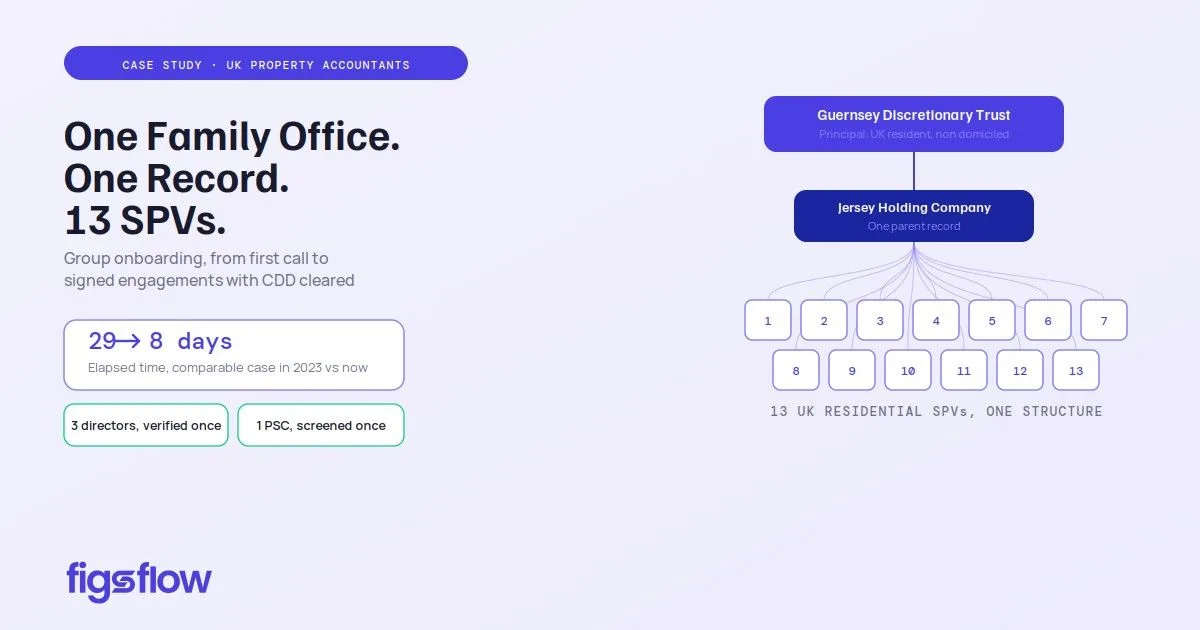
In March, we onboarded a new family office client. The principal is UK-resident but non-domiciled. The structure sits under a Guernsey discretionary trust that owns a Jersey holding company, which in turn owns 13 UK property SPVs holding a mixed residential and mixed-use London portfolio, including two properties above the £500,000 ATED threshold and one that qualifies for the property rental business relief. Three individuals are directors across the entities. One PSC sits across all of them. The Register of Overseas Entities filings had lapsed on two of the entities.
Historically, this onboarding would have taken a manager the best part of a month. Thirteen client folders. Thirteen engagement letters generated one at a time from a Word template. Identity documents for the three directors captured once and filed 13 times, with the unspoken risk that the version in folder six wasn't quite the version in folder 11. Risk assessments typed up in Word. Screening results printed and saved as PDFs somebody could see. A group structure drawn in Visio because the CRM had nowhere to hold it. ROE updates diarised as calendar entries. And a partner spending an evening cross-checking whether the same person had actually been evidenced against every entity where their name appeared.
On FigsFlow, the group went onto one parent record with the 13 SPVs beneath it. The Guernsey trust and the Jersey intermediate holding company were captured as first-class objects (not shoved into notes fields) so the structure diagram FigsFlow renders is the structure the record actually holds. Identity capture ran from each director's phone — passport, biometric selfie, address proof, and PEP and sanctions screening filed once against the individual and inherited by every entity in the group where they hold office. The risk assessment was completed at group level, with the reasoning stored on the record, and our MLRO ratified it in one review rather than 13.
Because the pricing engine held our rate card and our complexity factors, the fee for the whole group was computed from the actual scope — accounts and tax for 13 entities, ATED for the two in scope, ROE remediation for the two lapsed filings, corporation tax planning for the group, NRL confirmation for the individual, and a partnership incorporation review on an adjacent structure — rather than negotiated back and forth by email. One conversation. One acceptance. Thirteen engagement letters generated from that one acceptance, with clauses that vary correctly by entity type, and a variation prompt already staged for the de-enveloping review the client had mentioned but not commissioned.
Elapsed time from first call to signed engagements with CDD cleared was eight working days. On a comparable historical case in 2023, we took 29.
The 60-Day Rule That Used to Keep Partners Awake
A UK-resident client sold a second residential property in July. Because the disposal was subject to the 60-day CGT reporting and payment deadline, the return had to be filed and the tax paid within 60 days of completion.
The problem was that completion took place while the responsible manager was on annual leave. The client sent the completion statement to the firm's general enquiries inbox rather than directly to the manager. Under the old workflow, the deadline could easily have been missed because no one had picked up the case yet. That could have left the firm dealing with a late-filing penalty and a difficult question about who should have spotted the disposal.
FigsFlow changed that. Because CGT on UK residential property disposals had already been included as a scoped service in the client's April engagement, the 60-day deadline was automatically part of the engagement workflow. FigsFlow's deadline radar flagged the case on the following Monday, allowing a partner to reassign it immediately. The return was filed on day 41, with a second reviewer assigned before the work began.
The client never knew there had been a potential gap.
That is the difference between recording a deadline and building the deadline into the way the practice manages the engagement.
The £4,000 Fee We No Longer Forget to Bill For
SDLT and de-enveloping work throws off scope creep the way a building throws off dust. A Multiple Dwellings Relief amendment claim on a pre-June-2024 transaction surfaces a mixed-use argument, which surfaces a related overpayment on an earlier transaction, which surfaces a de-enveloping question, which surfaces an IHT planning conversation the client hadn't realised they wanted. Historically, we did the work and either wrote it off as goodwill or had an uncomfortable conversation with the client about additional charges.
The engagement letter now locks the agreed price on signature. Anything outside the scoped services on the record triggers a variation prompt before the work begins. We send a short variation letter generated from the service library, the client accepts it in the portal, and the work is billed as agreed extras rather than absorbed as a write-off. On the 12 advisory engagements that have run through the platform this way, recovered fees have averaged 113% of original scope, all of it agreed in advance.
Things That FigsFlow Replaced at UK Property Accountants
The easiest way to see what changed after we introduced FigsFlow is to look at the systems and workarounds we no longer need:
- The master client spreadsheet that lived on a shared drive and had 47 tabs by the end
- The Word engagement letter template folder, and the six subtly different versions of the “standard” letter that had accumulated in it
- The AML tracker one manager maintained in Excel and worried about losing
- The Outlook shared calendar for statutory deadlines, and the Monday morning half-hour spent reconciling it
- The email chain that used to precede every proposal, “What did we quote them last time?”
- The internal message that used to follow every completion, “Has anyone told the CGT team?”
- The January conversation about which engagements were underwater and why nobody had raised it in October
Conclusion
At UK Property Accountants, the problem was never a lack of tools. We had spreadsheets, Word templates, Excel, Outlook and many software. Each one worked on its own. The problem was that none of them gave the whole firm one connected view of the client, the engagement and everything that needed to happen around it.
FigsFlow replaced that fragmented workflow with a single system built around how our work actually moves, from proposal and engagement through AML/KYC, payment, onboarding, deadlines and delivery.
That is why we are still using the platform. That’s probably the strongest recommendation we can give.