
Weekly News & Updates for UK Accountants (7-11 September 2026)
If you have clients caught by the loan charge, tell them to act. HMRC's settlement scheme cuts bills by up to 50%, and some are settling at zero liability.
 Swikriti ThakuriSep 11, 2026Updated Sep 28, 2026
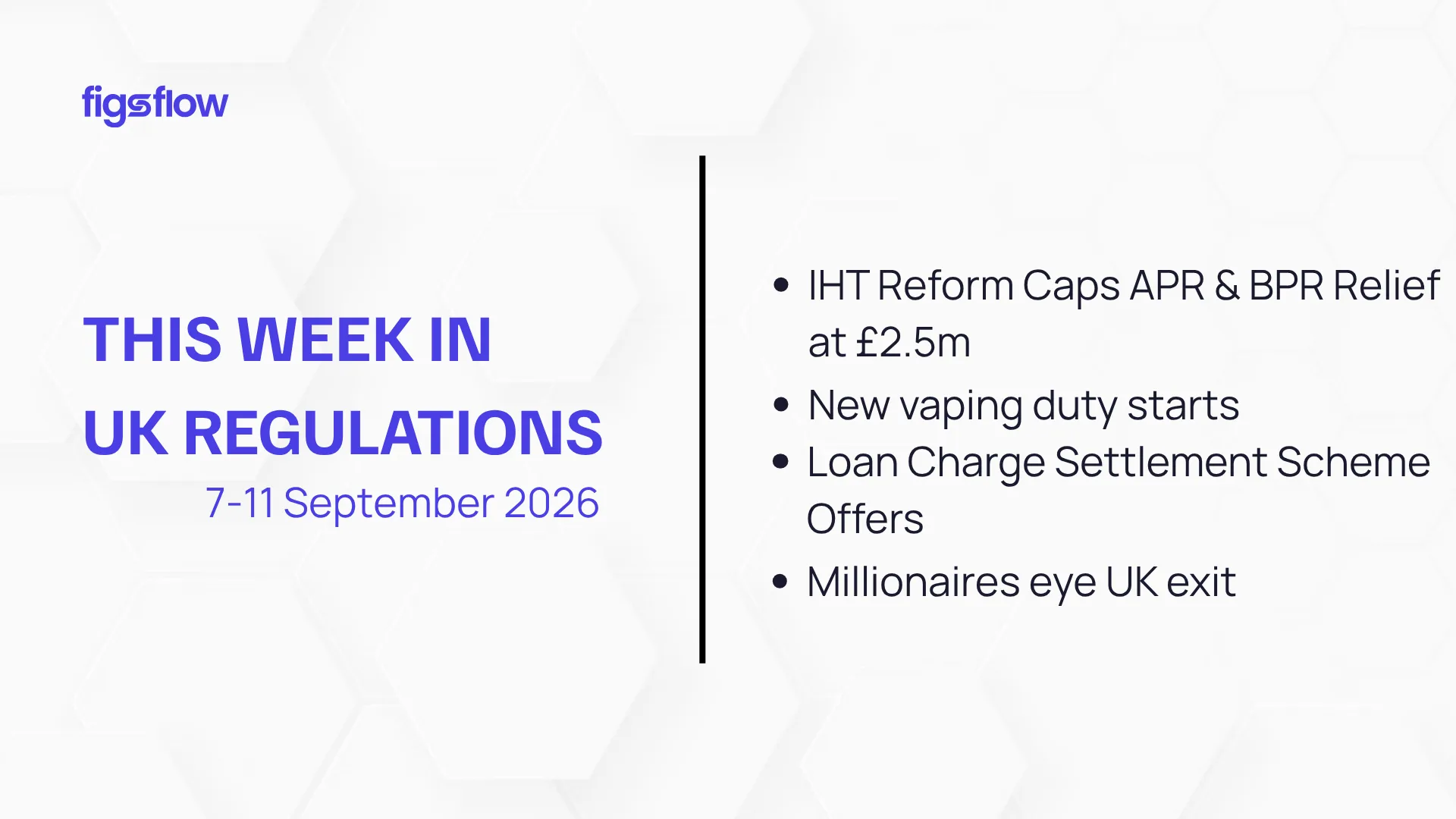
HMRC's Loan Charge Settlement Scheme has been live since 5 August 2026, giving up to 40,000 affected taxpayers a 90-day window to settle, with reductions of up to 50% and some reaching zero liability. That is the story to act on first. Close behind it, the new vaping duty and stamp scheme land on 1 October, leaving under three weeks for approval.
The other two are about planning rather than panic. The new £2.5 million cap on Agricultural and Business Property Relief is reshaping how wills and trusts are drafted, and a fresh survey shows most UK millionaires have at least considered leaving the country.
Here is the detail.
IHT Reform Caps APR & BPR Relief at £2.5m
Full relief under Agricultural Property Relief and Business Property Relief has been capped at £2.5m per individual or trust since 6 April 2026. Property above that threshold receives only 50% relief, an effective 20% inheritance tax charge rather than the standard 40%, with ten years allowed to pay.
The allowance is fully transferable between spouses and civil partners, creating a combined £5m allowance on the second death, even where the first spouse died before 6 April 2026 or held no relievable assets at all.
Key facts:
- 100% relief is capped at £2.5m per individual or trust from 6 April 2026; the excess gets 50% relief, an effective 20% IHT rate
- Spousal transferability gives up to £5m combined on the second death, regardless of when the first spouse died
- Instalment relief lets the tax be paid over 10 years at 0% interest, against HMRC's standard 7.75% rate; holding assets in a private company preserves this even after a sale, but direct personal sales lose it immediately
The bigger risk is in how wills are drafted. Combining relievable and non-relievable assets in one residuary trust triggers the section 39A apportionment rules in the Inheritance Tax Act 1984, splitting the 100% relief 50/50 between gifts even where relievable assets are separately appointed to children within two years, leaving children's shares with only 50% relief and a potential £250,000 charge.
Specifically gifting APR and BPR assets into a separate discretionary trust under the will avoids the trap. Review clients' wills now, particularly where farms or family businesses sit alongside other assets, and consider lifetime transfers between spouses where age or health make the gifting window a live issue.
New Vaping Duty & Stamp Scheme Start 1 October
A flat excise duty of £2.20 per 10ml bottle, or 22p per ml, applies to all vaping liquid manufactured in or imported into the UK from 1 October 2026, regardless of nicotine content. A 2ml pod carries 44p of duty, a 10ml refill bottle £2.20.
Every product will also need a duty stamp, physical or digital, carrying a scannable authentication code on the outermost retail packaging. Digital stamps have been available since 1 September 2026, and manufacturers, UK representatives and warehouse keepers must have HMRC approval in place by 1 October.
Key facts:
- Duty rate: £2.20 per 10ml bottle (22p per ml), charged regardless of nicotine content, from 1 October 2026
- HMRC approval for manufacturers, UK representatives and warehouse keepers is required by 1 October 2026; importers must pay duty on arrival unless goods enter an approved duty-suspended warehouse
- Transitional stamps can be bought until 30 November and affixed until 31 December, with a six-month window (1 October 2026 to 31 March 2027) to sell existing unstamped stock
HMRC has warned that non-compliant businesses face trading halts, operational delays and civil or criminal sanctions. Any client manufacturing, importing or selling vaping liquid should have their approval status and stamping plans confirmed well before 1 October.
Loan Charge Settlement Scheme Offers Up to 50% Reductions
The Employment and Trading Income etc (Loan Charge Settlement Scheme) Regulations 2026, SI 2026 No. 821, took effect on 5 August 2026, offering up to 40,000 individuals and businesses a route out of disguised remuneration loan charge liabilities.
Reductions of up to 50% are available, with around a third of affected taxpayers able to settle at zero liability, and individual reductions reaching as much as £70,000. Associated inheritance tax liabilities on underlying trusts or loan arrangements can also be written off, provided the arrangement is formally closed down.
Key facts:
- Bill reductions of up to 50%, with roughly a third settling at £0 and individual reductions of up to £70,000
- 90 days from the offer date to accept (30 days for subsequent offers), with HMRC Commissioners able to extend, and longer periods available for most clients
- Liabilities already settled under formal contract settlements entered into before 1 June 2021 are excluded
Every affected taxpayer has a named HMRC caseworker, and clients do not need to wait for a formal letter before making contact. Given the technical complexity, both HMRC and BDO's tax dispute resolution team are urging specialist advice before any final agreement is signed, so this is worth raising proactively with any client who may be affected.
Millionaire Exodus Warning as 61% Consider Leaving the UK
A Wealth Club survey of more than 300 millionaire clients, with average wealth of £4.5m, found that 61% have considered becoming non-UK tax resident because of the tax burden, and 97% expect taxes to rise over the next 12 months, with 53% calling further rises inevitable.
Inheritance tax was the top concern at 22%, ahead of a wealth tax at 21% and capital gains tax at 18%. Most of this wealth was built rather than inherited: 40% from employment, 33% from investment, only 2% from inheritance.
Key facts:
- 61% have considered non-UK residency, though only 16% are actively considering leaving and 36% have never considered it
- 97% expect taxes to rise in the next 12 months; top concerns are IHT (22%), a wealth tax (21%) and CGT (18%)
- Chris Rokos, founder of Rokos Capital Management, is reportedly moving tax residency to Greece, which requires a flat €100,000 (£85,000) annual tax for up to 15 years plus a €500,000 investment within three years
Also In The News
- Weekly News & Updates for UK Accountants (10-14 August 2026)
- Enhanced Due Diligence (EDD) Explained
- UK Money Laundering Regulation (MLR) Amendment: What is Changing in 2026?
- The Real Cost of a Bad Engagement Letter
Conclusion
The pattern this week is HMRC tightening deadlines on one side while easing settlement terms on the other. The loan charge scheme and the new vaping duty both carry hard dates and real consequences for missing them, while the IHT cap on APR and BPR is a drafting problem to solve rather than a deadline to meet. The Wealth Club survey is a reminder that clients are increasingly weighing whether to stay in the UK system at all.
For most practices the immediate work is narrow: flag the loan charge settlement window and the 1 October vaping duty deadline to affected clients now. The will reviews and residency conversations can follow at a steadier pace, but should not be left indefinitely.
We publish these updates every week. Follow us to get next week's round-up as soon as it lands.