
Weekly News & Updates for UK Accountants (2-6 November 2026)
Your clients' second MTD quarterly submission is due on Saturday. Are you ready? In fact, more importantly, are they? Read our newsletter to find out more.

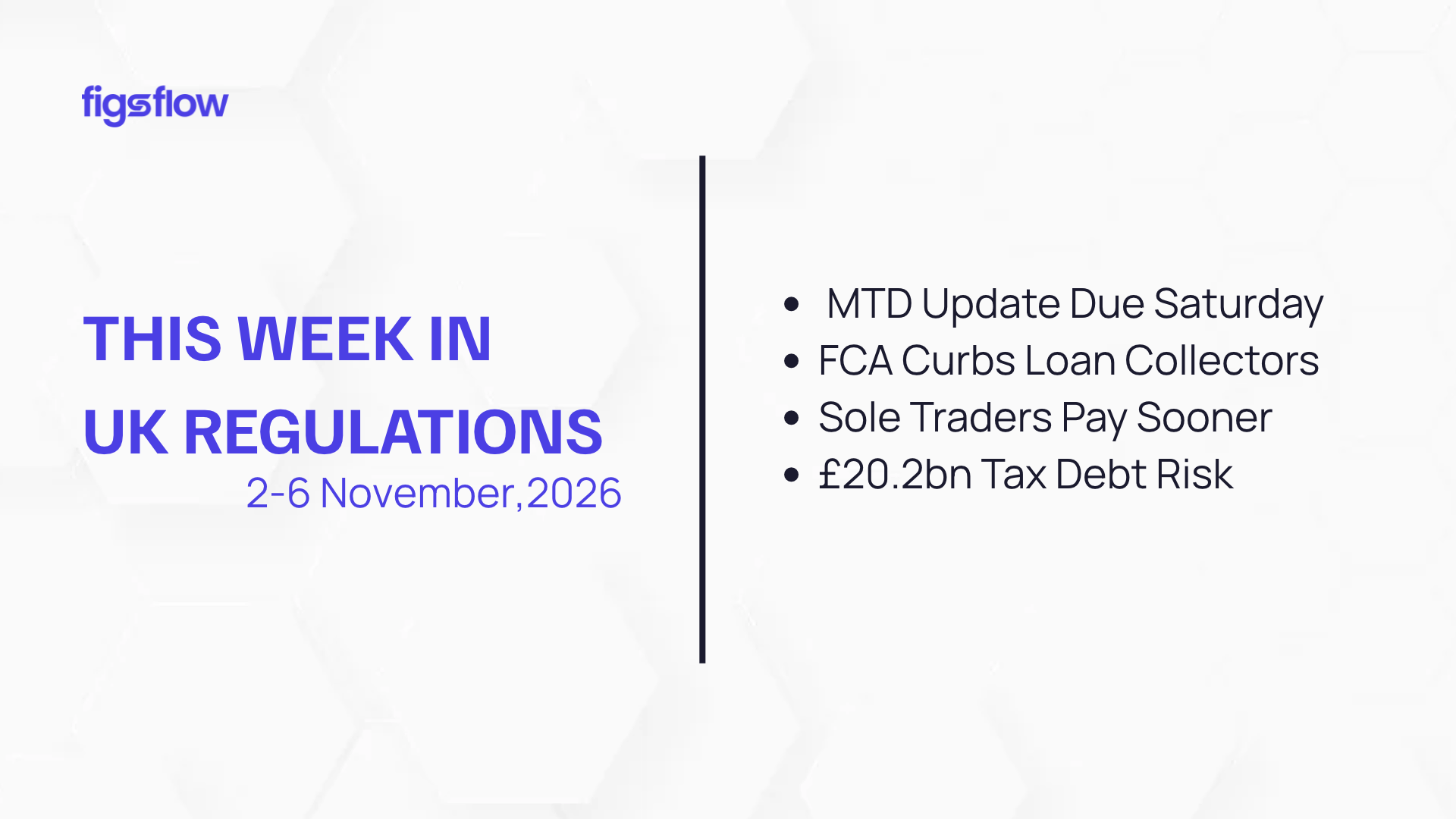
The second MTD for Income Tax quarterly update for the £50,000+ cohort is due on 7 November, which falls this Saturday. That is the story to act on first. Close behind it, the FCA has warned debt collectors chasing disguised remuneration loans that, without a Validation Order, those debts cannot be enforced.
The other two are about planning rather than panic. The Budget moves sole traders to in-year tax payments from April 2029, and a National Audit Office report puts £20.2bn of HMRC's £43.8bn tax debt at high risk of never being collected.
Here is the detail.
MTD Quarterly Update Due Saturday & MTAR Window Opens
Self-employed individuals and landlords with qualifying income above £50,000 now face their second quarterly update under MTD for Income Tax. For clients in their first mandated year, this is where the routine either sticks or slips, and a deadline shared with VAT returns leaves little room for a late scramble.
A quieter deadline opens later this month. Advisers whose only interaction with HMRC is delivering payroll services for third parties get a three-month window to register on the Mandatory Tax Adviser Register (MTAR).
Key deadlines:
- 7 November 2026: second MTD quarterly update for the £50,000+ cohort, alongside VAT returns and payments for periods ended 30 September 2026.
- 18 November 2026 to 17 February 2027: MTAR registration window for payroll-only tax advisers.
- 30 December 2026: last date to file a 2025-26 return online for an underpayment under £3,000 to be collected through the 2027-28 PAYE code.
Check this week which £50,000+ clients have not yet submitted. If your practice, or a payroll provider you work with, deals with HMRC only on payroll, diarise 17 February.
FCA Warns Disguised Remuneration Loan Collectors
Clients who used disguised remuneration schemes are receiving a second wave of demands, this time from debt collection agencies rather than HMRC. The agencies have bought historic loan books from promoters or liquidators and are threatening court action to recover the loan principal, often after the client has already settled the tax.
The FCA's response, set out in its statement "Demands for Disguised Remuneration Scheme Loan Repayments", is that an agency recovering these loans must obtain a Validation Order. Where one is needed and not granted, the loan contract is unenforceable.
HMRC has confirmed it has not appointed or instructed any of these collectors, and treats enforceability as a private civil matter for the courts.
Key points:
- Collectors need an FCA Validation Order, and the FCA says approval is "by no means guaranteed".
- Without a specific court order, a borrower cannot be forced to repay or have assets seized.
- Undue pressure can be reported to the FCA on 0800 111 6768.
For any client holding one of these letters, the advice is to pause: no voluntary payments and no new acknowledgements. Check whether the collector holds a Validation Order, confirm the client's position under the Loan Charge Settlement Scheme, and refer them to a consumer credit specialist.
Sole Traders Face In-Year Tax Payments From April 2029
For a sole trader on £100,000 of profit, the Budget's main change for the self-employed means finding an extra £15,000 to £23,000 in cash during the changeover. From April 2029, Self Assessment taxpayers on payments on account move to compulsory in-year payments, collected by Direct Debit by default.
The Treasury scores this at £1.3bn in 2029-30, but the liability itself is unchanged. It is a timing acceleration, funded from working capital, often before customers have paid. A company with taxable profits up to £1.5m still pays corporation tax nine months and one day after its year end.
Andy Oury ACA CTA of Oury Clark says MTD places "the compliance load of a company with a finance department on a person with a van". The offsets are modest: the trading allowance triples from £1,000 to £3,000, which mainly helps small side incomes, and Class 4 NICs stay at 6%.
Key figures:
- April 2027: the MTD for Income Tax threshold falls to £30,000 of qualifying turnover.
- April 2028: the threshold falls again, to £20,000.
- April 2029: in-year tax payments begin, with Direct Debit as the default.
Start the cash flow conversation now with sole trader clients caught by both the lower MTD thresholds and the 2029 changeover, so the extra cash is planned for rather than found at the last minute.
NAO Flags £20.2bn of HMRC Tax Debt at Risk
The National Audit Office finds that 8.2 million taxpayers, around one in six UK adults, owed HMRC a combined £43.8bn at the end of 2025-26. That is 20% below the pandemic peak but more than double the £19.0bn owed in 2019-20.
HMRC's systems are part of the problem. Collectors work across 103 separate IT systems, use up to 17 applications on a single case, and take 40 to 90 minutes to agree a multi-debt payment plan. A cloud-based Customer Debt Collection Service is replacing the legacy system.
Not all of it is bleak. Nearly half of new debt is resolved within a month, pointing to cash flow timing and admin slips rather than an inability to pay.
Key figures:
- £20.2bn, or 46% of the total, is at high risk of never being collected.
- £18.6bn is over a year old and not covered by a Time to Pay arrangement.
- HMRC recorded £12.9bn of debt losses in 2025-26.
For clients with arrears, early engagement and a Time to Pay arrangement keep them out of the group HMRC struggles with most: older debt with no plan in place.
Conclusion
The pattern this week is tax being pulled in earlier while HMRC struggles to collect what it is already owed. Sole traders will pay in-year from 2029, yet £20.2bn of existing debt is at high risk of loss. And where private collectors have pushed too hard on disguised remuneration loans, the FCA has stepped in.
For most practices the immediate work is narrow: get the £50,000+ MTD updates in by Saturday 7 November, and check any client holding a disguised remuneration demand letter before they pay. The MTAR window from 18 November and the 2029 cash flow conversations are planning and watching.
We publish these updates every week. Follow us to get next week's round-up as soon as it lands.