
Companies House Director Search: Complete UK Accountant Guide
Search directors by name, read the officers list field by field, and work out how long a director has served — including the resignations that never got filed.

In 9 minutes, you’ll learn exactly where to find information about Companies directors for for AML checks, client onboarding, and due diligence.
How long did your last director verification take? Ten minutes? Thirty minutes? Longer?
How many browser tabs did you have open? Company website, LinkedIn, Google, maybe a few “people finder” sites that wanted £20 for partial information?
What if the complete, verified information you needed was free and accessible with a simple Companies House Director Search?
It is. And in the next 9 minutes, you’ll learn exactly where to find it and how to use it for AML checks, client onboarding, and due diligence.
Why UK Accountants Need to Perform Director Searches for AML Compliance
Before accountants take on new clients, they’re required to know their customers and perform due diligence based on their risk levels. This involves Customer Due Diligence (CDD), Enhanced Due Diligence (EDD), PEP screening, and identifying and verifying beneficial ownership and Persons with Significant Control.
Director searches matter for three reasons:
- You need verified identity information for AML compliance
- You need to prevent conflicts of interest across your client base
- You need accurate director details for filing tax returns and preparing statutory accounts.
Without verified director information, you’re building client relationships on assumptions rather than facts.
Director checks also prevent conflicts of interest that damage client relationships. That new client director might sit on the board of your existing client’s competitor. Or they might be a director of three dissolved companies in the past two years. You’ll catch these patterns immediately when you search by officer name.
Where and How to Access Company Director Information in the UK
Companies House provides a free, public register where you can search for director information across all UK companies. The official service is called “Find and update company information”, and it’s available at find-and-update.company-information.service.gov.uk.
This is the only authoritative source for UK company director records. No registration is required to view information. The service is maintained by Companies House, which means you’re accessing the same database that companies file their information to, updated in real time as new filings are accepted.
When you search for company directors through this portal, you’ll find current and resigned officers, their appointment dates, correspondence addresses, and whether they’ve verified their identity with Companies House. If that identity verification deadline has passed without action, you’ve spotted your first compliance issue before you’ve even sent the engagement letter.
You can search by company name or number to see complete officer lists, or search by officer name to find every directorship that person holds across the UK register.
The Follow feature helps you monitor filing deadlines so you can spot overdue markers before they become crisis calls. When your client asks about a potential business partner or acquisition target, the director’s search history shows the patterns that matter for informed advice.
Step-by-Step Guide for Using Companies House Director Search
Step 1: Access the Companies House Search Service

Navigate to find-and-update.company-information.service.gov.uk. You’ll see a simple search box with no login required. This is your gateway to over 5 million company records.
Step 2: Enter Your Search Terms

Type “FigsFlow” into the search box. You can search by company name, company number, or officer name.
The search accepts partial matches and isn’t case-sensitive.
Step 3: Select the Company from the Results

The search returns “FIGS FLOW LIMITED” with company number 15655148, incorporated on 17 April 2024. Click the company name to view full details.
Step 4: Review the Company Overview

The overview tab shows company type (Private Limited Company), nature of business (62012 – Business and domestic software development), and critical compliance dates. For FigsFlow, first accounts are due 30 April 2025, with a filing deadline of 17 January 2026.
Overdue markers appear here if filings are late. This tells you immediately whether a company is compliant.
Step 5: Access Director Information

Click the “People” tab to see all current and resigned officers. For FigsFlow, you’ll find one director: Raju Gajurel, appointed 17 April 2024.
The director’s record shows role, date of birth, nationality, country of residence and correspondence address.
The identity verification date is new under the Economic Crime and Corporate Transparency Act 2023.
Step 6: Use Advanced Search Options

Click “Advanced company search” from the main search page to access detailed filters. Search by registered office address, incorporation date range, company status, nature of business, company type, or dissolved date.
You can also find all the companies where a person serves as a director. For this, just enter his name in the main search box. Companies House returns all his current and resigned directorships across the UK register.
Key Advanced Features of the Companies House Director Search Tool for Accountants
Companies House director search offers advanced features like automatic company monitoring, advanced search filters, cross-company officer searches, and API access for practice management integration.
Follow companies for automatic monitoring
The “Follow this company” button appears on every company record. Click it once, and you’ll receive email alerts whenever that company files anything.
Set up follows for all your clients and key business partners. The alerts link directly to filed documents, letting you review submissions without additional searches.
Advanced Search Filters
Companies House offers advanced search filters where you can combine eight different categories to answer specific questions. Filter by registered office address to find all companies at a location. Filter by incorporation date to see recently formed companies. Combine status and nature of business filters to find dissolved companies in specific industries.

Each filter accepts partial matches and date ranges, making complex queries manageable. You can search for all private limited companies with specific words in their name by combining company type and name filters.
Search by Officer Name Across All Companies
Reading the officers list: what each field actually tells you
First, a terminology note that trips people up. Companies House calls them officers, not directors. An officers list mixes directors and company secretaries, and it shows people who have left alongside people still in post. Searching “director” and reading “officer” is the source of most confusion here.
Searching an officer name returns a list of people rather than companies, and each result carries four things worth understanding:
- Name — as filed, which is why the same person can appear several times with different middle names or spellings. Names are not deduplicated.
- Total number of appointments — across every company, current and former. A high number is not suspicious on its own; accountants, company secretaries and serial founders all rack them up.
- Address — the service address, not a home address. Residential addresses are not published.
- Month and year of birth — shown as “Born February 1947”. The full date of birth is not public, which matters: you can use it to tell two people of the same name apart, but not as an identity check.
Be realistic about scale. A search for a common name like “John Smith” returns hundreds of thousands of matches, so name alone is rarely enough — you narrow it with the month and year of birth, the address, or by working back from a company you already know they are attached to.
All of it is free. The register charges nothing to search companies, officers, appointment history or filing history.
Appointment dates and how long a director has served
Each appointment carries an appointed on date, and where the person has left, a resigned on date. That pairing is more useful than it looks.
Working out tenure. There is no “length of service” field — you calculate it from the appointment date to either today or the resignation date. To find the longest-serving director of a company, open the company’s officers list and sort by the earliest appointment date; the oldest date still without a resignation is your answer. Bear in mind the register only holds what was filed, so a director whose appointment predates the company’s digitised records may show a later date than their actual start.
What the dates reveal in practice. A cluster of resignations on the same date usually means a sale, a restructure or a fallout. A director appointed days before a company took on a charge is worth a second look. Repeated short appointments across unrelated companies is a pattern worth noting in a risk assessment. And an officers list that has not changed in fifteen years tells you something about succession planning, which is a conversation rather than a red flag.
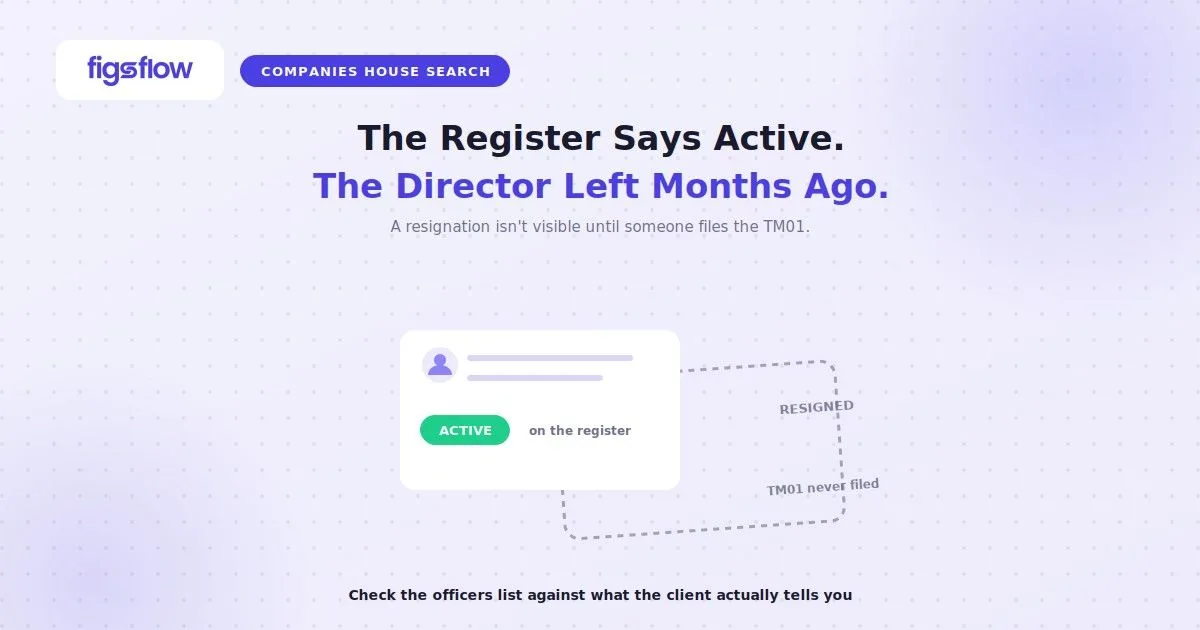
The gap that catches practices out. Resignations are only on the register once someone files them. A director who left months ago but whose TM01 was never submitted is still shown as active, and still being counted as a director for filing purposes. If you are taking on a new client, check the officers list against what the client tells you — the discrepancy is common, and correcting it is usually the first piece of work.
When you need to find every company where someone serves as a director, enter their name in the main search box and select the “Officers” tab.

Companies House returns all their current and resigned appointments, showing company names, appointment dates, and current status. This cross-company view reveals whether someone simultaneously directs competing businesses, holds directorships in dissolved companies, or maintains appointments in companies your client plans to partner with.
API access for practice management integration
Companies House offers a free API for automated data access. If your practice management software supports it, you can pull company and director data directly into your systems without manual searches.
FigsFlow, the complete client onboarding platform, integrates with Companies House to automate director verification and company lookups. This lets FigsFlow users verify client details instantly during onboarding, automatically check company status and director appointments, and pull filing history without leaving the platform
For practices handling high volumes of new client onboarding or ongoing compliance monitoring, this integration eliminates repetitive manual searches.
Important Limitations & Disclaimers
- Companies House Does Not Verify Information Accuracy – Documents are accepted if properly completed and signed. Directors can file false information. Companies House records are your starting point, not proof. Always conduct independent verification for AML compliance.
- 20-Year Retention Creates Historical Complexity – Dissolved company records are now retained for 20 years. Director searches return old appointments. A dissolved company from 2010 carries less weight than one from last month. Context matters.
- Data Protection Affects What’s Shown – Directors can restrict home address disclosure for safety reasons. You might see service addresses instead of residential addresses. Collect actual addresses directly from clients for AML verification.
- Identity Verification Is Self-Certified – Directors verify their own identity through GOV.UK One Login or Companies House. This confirms someone can prove their identity, not that they’re the legitimate director. Your due diligence must verify that the person you’re dealing with matches the verified director.
- Filing Delays Mean Records Aren’t Real-Time – Companies House shows what’s been filed, not what’s current. A director might have resigned yesterday, but still appears active until the form TM01 is filed. For time-sensitive matters, get current confirmation directly from the company.
Helpful Resources
- Companies House Advanced Search Function: Using the Companies House advanced search function – Companies House
- Getting Started with Companies House API: Get started with the Companies House API
- Guidance on Searching the Companies House Register: Searching the Companies House register – GOV.UK
- UK Sanctions Screening Guide: How to Perform Sanction Screening for Clients in the UK | FigsFlow
- Guide to AML Risk: What Is Money Laundering? Definition, Process & Examples | FigsFlow
Important Deadlines for Director Identity Verification: What You Need to Know
If you’re using the Companies House director search today, you may have already noticed important changes in how officer information is displayed and managed.
As we progress through 2026, the UK government is finalising the rollout of the Economic Crime and Corporate Transparency Act, which introduces stringent new requirements for all company officers across the country.
The November 2026 Deadline: Your Final Reminder
The most important date to remember is 18 November 2026 – the end of the 12-month transition period for the UK’s 7 million existing directors. By this deadline, all directors must verify their identity and link it to their company appointments.
What this means for you: Failure to verify your identity by this date will result in severe consequences. Acting as an unverified director after 18 November 2026 will become a criminal offence. Penalties include:
- A fine of up to £5,000,
- Director disqualification, or
- Potential company strike-off from the register.
Updated Filing Fees: Effective from 1 February 2026
In order to fund these new security measures, the cost of maintaining a company is set to rise. Expect the following digital fee updates:
- Confirmation Statement: £50 (up from £34),
- New Incorporations: £100 (up from £50),
- Voluntary Strike-off: A price reduction to £13, making it more affordable to close dormant companies.
The “Verified” Status & Personal Codes
When performing a director search, you will soon see a “Verified” status next to officer names. This verification occurs once a director uses their unique 11-character Companies House personal code – which acts as a digital passport. After verification, the same code will link all directorships across the UK company register, providing protection against identity theft and fraud.
Who Can File for You? (Changes from Spring 2026)
From Spring 2026, the rules around who can file documents on your behalf are changing. No longer will an unverified third party, including accountants, be able to submit your paperwork. Anyone filing on your behalf must be identity-verified and registered as an Authorised Corporate Service Provider (ACSP).
Conclusion
Companies House director searches are free, comprehensive, and essential for AML compliance. The interface is straightforward if you know what you’re looking for.
Start with the “Follow” feature for existing clients. Build director searches into every new client onboarding. The 5 minutes you spend now prevent compliance failures later.
Search Company Directors in Seconds
Free access to 5+ million company records. Verify directors, check appointments, and monitor filings instantly.