
Bookkeeping Engagement Letter: Free Template, Key Clauses & Client Protection Guide
A bookkeeping engagement letter sets recurring scope, fees and boundaries with clients. Use this free template to standardize every new engagement.

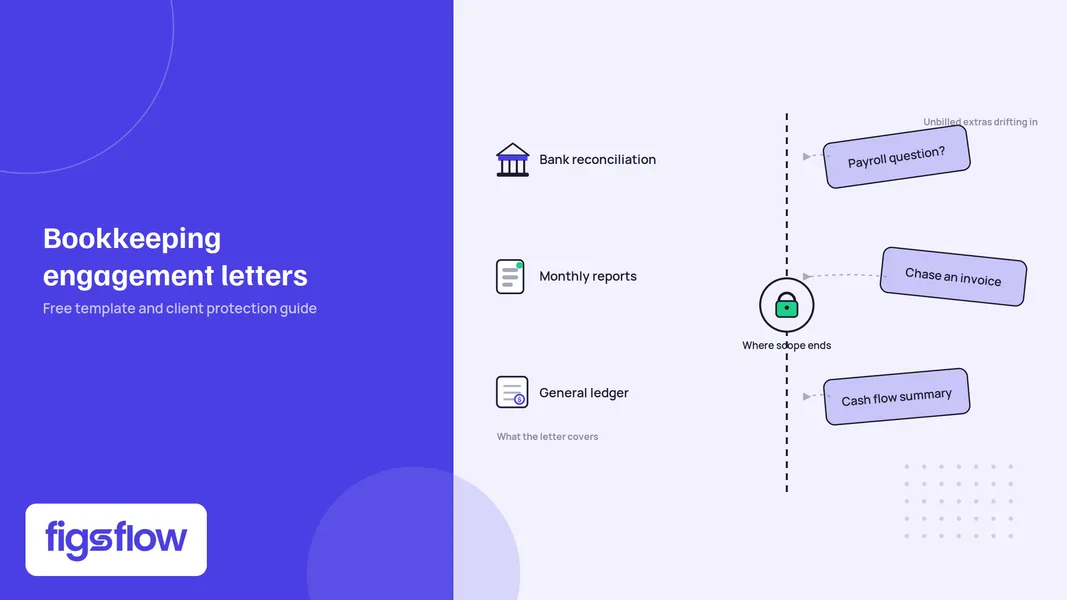
A client hires you for monthly bookkeeping. A few months in, they start asking for extras. A payroll question here, a chased-down invoice there, a quick cash flow summary before a bank meeting. You never charged for any of it. It all became your job anyway. That is scope creep, and it turns a profitable engagement into unpaid work faster than anything else. The cause is almost never a bad client. It is that nobody wrote down where the work stops.
A bookkeeping engagement letter is that written boundary. It is a signed agreement stating what you deliver, what you do not, what the client owes you, and what happens when something goes wrong.
Here is what belongs in one, the clauses that protect your firm, a free template, and sample language you can use today.
What Is a Bookkeeping Engagement Letter?
A bookkeeping engagement letter is a written agreement between a bookkeeping provider and a client. It explains the bookkeeping services that will be performed, the fees the client will pay, the information the client must provide, and the boundaries of the engagement.
In simple terms, it tells both sides what to expect.
Bookkeeping engagement letter defines the scope of work and helps prevent clients from assuming that every financial task is included. For the client, it provides clarity on what services they are receiving, when work will be completed, and what they need to do to keep the process moving.
The point is shared understanding. The client knows exactly what they are paying for. You know exactly what you agreed to do. When a request falls outside those terms, the letter is what lets you say so without a confrontation.
A signed engagement letter can carry legal weight as a contract, depending on how it is written and executed. It also helps document what your firm is, and is not, responsible for.
Why Bookkeeping Firms Need an Engagement Letter
A bookkeeping engagement letter helps your firm define exactly what services are included. It also makes it easier to explain when a request falls outside the agreed scope and should be quoted separately.
It also clarifies the client’s responsibilities. Bookkeeping depends on accurate and timely records. If the client does not provide bank statements, receipts, invoices, payroll information, or explanations for unusual transactions, the work may be delayed. An engagement letter makes that clear from the beginning.
A well-written letter also sets payment expectations. It should explain whether the client will pay a monthly fixed fee, an hourly rate, a setup fee, or additional charges for out-of-scope work. This reduces the chance of billing disputes later.
In short, a bookkeeping engagement letter helps your firm:
- Define the exact services included, so “bookkeeping” is not left to interpretation
- Reduce scope creep, because work that is not named is not owed
- Clarify client responsibilities, such as delivering records on time
- Set payment expectations, including due dates and out-of-scope rates
- Protect the firm from misunderstandings over deliverables and fees
- Create a consistent onboarding process, so every client starts the same way
What Should a Bookkeeping Engagement Letter Include?
A bookkeeping engagement letter should be specific enough to guide the relationship, while also being practical to apply in day-to-day work and clear enough for the client to understand. The goal is not to make the document unnecessarily complicated. The goal is to make sure the client knows what is included, what is excluded, what they must provide, and how the engagement will work.
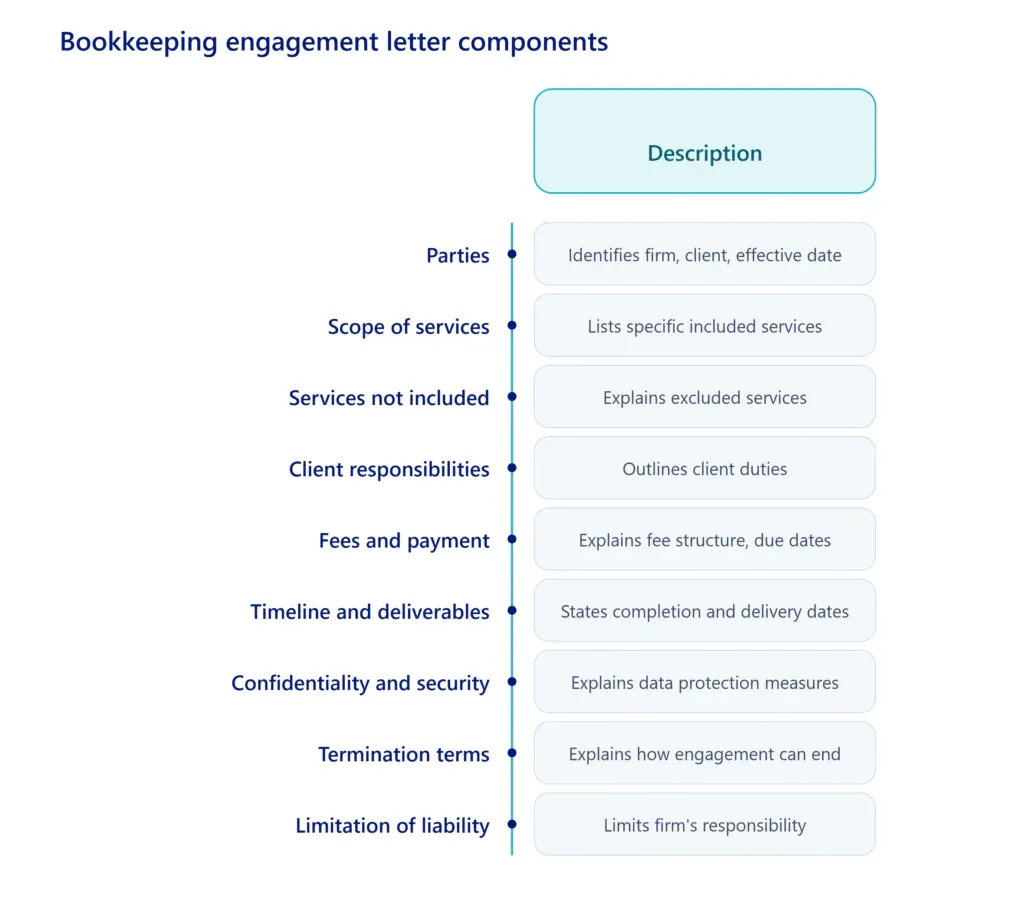
Below are the key sections every bookkeeping engagement letter should include.
Parties to the Agreement
The engagement letter should clearly identify the parties involved.
This usually includes:
- The name of the bookkeeping firm
- The name of the client
- The client’s business name
- The effective date of the agreement
If the client operates through a business entity, the engagement letter should use the correct legal or business name. This helps avoid confusion about who is responsible for payment, recordkeeping, and approvals.
This section does not need to be long. It simply establishes who the agreement is between and when the engagement begins.
For example, “This engagement letter confirms the terms under which ABC Bookkeeping Services will provide bookkeeping services to XYZ Company, effective January 1, 2026.”
Scope of Bookkeeping Services
The scope of services is one of the most important parts of the engagement letter. This section explains exactly what your firm will do for the client.
List the actual work. This section should be specific. Instead of saying “monthly bookkeeping services,” list the actual tasks your firm will complete.
For example, if your firm will reconcile two bank accounts and one credit card account each month, say that. If the client has additional accounts that require separate pricing, make that clear.
If your firm provides monthly financial reports, explain which reports are included. These may include a profit and loss statement, balance sheet, cash flow report, general ledger, or accounts receivable aging report.
The clearer this section is, the easier it will be to manage the client relationship.
Services Not Included
Naming what you deliver is only half the boundary. The exclusions do the other half. State plainly what falls outside this engagement. Clients may not always understand the difference between bookkeeping, tax preparation, payroll, advisory work, and financial statement services. If excluded services are not listed, the client may expect your firm to handle work that was never included in the fee.
This section is especially important for firms that offer more than one service. If your firm provides bookkeeping and tax services, the engagement letter should make clear whether tax preparation is included in this specific engagement or handled under a separate agreement.
A clear excluded-services section helps prevent scope creep and makes it easier to quote additional work separately.
Client Responsibilities
Bookkeeping is not a one-sided service. Your firm can only complete accurate work if the client provides complete, timely, and accurate information.
The client responsibilities section should explain what the client must do during the engagement.
This may include responsibility for:
- Providing accurate records
- Sharing bank statements, receipts, invoices, and other documents
- Granting access to accounting software or financial accounts when needed
- Responding to questions on time
- Reviewing reports
- Making business decisions
- Approving transactions or adjustments when required
This section should also make clear that management decisions remain the client’s responsibility. A bookkeeper may organize records, reconcile accounts, and prepare reports, but the client is still responsible for operating the business and making final decisions.
For example, your firm may prepare monthly reports, but the client is responsible for reviewing those reports and notifying your firm if something appears incorrect.
You may also want to explain that delays in receiving client information can delay deliverables. If the client does not provide bank statements or transaction details on time, your firm should not be responsible for missing a reporting deadline.
Fees & Payment Terms
Ambiguity here becomes a collections problem later. State the fee structure clearly.
- Monthly fixed fee, hourly rate, or both
- Setup or onboarding fee, if any
- The rate for out-of-scope work
- Payment due dates
- Late payment terms
If your firm charges a monthly fixed fee, explain what that fee includes. For example, the fee may cover monthly bookkeeping for a specific number of accounts, transactions, or entities.
If your firm charges hourly for additional work, include the hourly rate and explain when it applies.
You should also include payment terms. For example, invoices may be due upon receipt, within 7 days, or within 15 days. If late fees apply, they should be clearly stated and reviewed for compliance with applicable law.
This section should also explain how out-of-scope work will be handled. A common approach is to state that additional work will require written approval before it begins.
Clear payment terms reduce billing disputes and make it easier to enforce your firm’s policies.
Timeline & Deliverables
Set expectations on timing so “when will my reports be ready?” is already answered. Cover when the monthly work is completed, when reports are delivered, and, critically, what happens when the client is late.
Tie the timeline to client cooperation. If documents arrive on the twentieth instead of the fifth, the delivery date moves with them, and the letter should say that in advance.
For example, “Monthly bookkeeping reports will be delivered within 10 business days after the client provides all required records, explanations, and access needed to complete the work.”
Confidentiality & Data Security
Bookkeepers handle sensitive financial information, so confidentiality and data security should be addressed in the engagement letter.
This section should explain that your firm will take reasonable steps to protect client information and handle financial records securely.
It may also mention:
- Use of cloud accounting software
- Use of third-party apps
- Secure document sharing
- Client access permissions
- Responsibility for maintaining secure login credentials
If your firm uses software tools to deliver services, the engagement letter should make clear that third-party platforms may be involved. This may include accounting software, document collection tools, e-signature platforms, practice management systems, or payment processors.
The client should also understand their own responsibilities. For example, they may be responsible for maintaining secure passwords, using appropriate access controls, and providing accurate permissions.
This section does not need to become overly technical, but it should show that both confidentiality and secure handling of data are part of the engagement.
Termination Terms
Plan the exit before you need it. Without termination terms, a client can walk mid-month and leave you unpaid for completed work. State how either party ends the engagement, the required notice period, such as 30 days, how final invoices are settled, and how records are returned or transferred.
For example, the engagement letter may state that either party can terminate the agreement with 30 days’ written notice.
Limitation of Liability
The limitation of liability section explains the limits of your firm’s responsibility. Because this section can have legal consequences, it should be reviewed by an attorney before use.
In general, this section may clarify that your firm is not responsible for errors caused by incomplete, inaccurate, or late information provided by the client. It may also explain that the client remains responsible for management decisions, tax positions, and business decisions.
For example, your firm may categorize transactions based on information provided by the client. If the client provides incorrect information, your firm should not be held responsible for decisions made from that incorrect information.
This section may also limit the types or amount of damages your firm may be responsible for, depending on applicable law and professional guidance.
Free Bookkeeping Engagement Letter Template
The following is a short sample of a bookkeeping engagement letter for illustration. Adapt it to your services and have an attorney review the legal clauses before use.
Download the sample bookkeeping engagement letter (PDF) →
Common Mistakes to Avoid in a Bookkeeping Engagement Letter
A bookkeeping engagement letter is only useful if it is clear, specific, and aligned with the actual services being provided. Many firms use engagement letters, but still run into problems because the document is too generic or incomplete. Here are common mistakes to avoid.
- Vague scope. “Bookkeeping services as agreed” invites the client to interpret it broadly, which they always will
- No exclusions listed. Naming what you do without naming what you do not leaves the boundary half-drawn
- Tax, payroll, and advisory left unclear. These are the services clients most often assume are included
- Undefined client responsibilities. Without dated obligations, late records become your problem
- No payment terms. Missing due dates and late terms turn into collections disputes
- No delivery timeline. “When are my reports ready?” should never be an open question
- Starting work before the client signs. An unsigned letter protects no one
- Reusing the old letter after scope changes. When the work changes, the letter must change with it
How FigsFlow Helps With Bookkeeping Engagement Letters
Creating a good bookkeeping engagement letter is only part of the process. Your firm also needs a simple way to send it, track it, get it signed, and keep it organized.
FigsFlow helps accounting and bookkeeping firms manage engagement letters more efficiently.
With FigsFlow, your firm can create reusable engagement letter templates, customize them for each client, send them for signature, and track which letters have been signed or are still outstanding.
This helps your firm standardize client onboarding and reduce the manual admin work that often comes with managing engagement letters through email, PDFs, and disconnected folders.
FigsFlow can help your firm:
- Create reusable engagement letter templates
- Send letters to clients
- Collect e-signatures
- Track signed and unsigned letters
- Standardize client onboarding
- Keep client agreements organized
- Reduce manual admin work
For bookkeeping firms that manage recurring client relationships, this creates a more consistent and professional process from the start.
Send and e-sign bookkeeping engagement letters in minutes with FigsFlow.
Further Reading
- CPA Engagement Letters: 9 Clauses, Sample & Risk Guide | FigsFlow
- Tax Preparation Engagement Letter + Free Template | FigsFlow
- Engagement Letter: What It Is & Why It's Important for Accountants
- Best Engagement Letters for Accountants | FigsFlow
Conclusion
A bookkeeping engagement letter gives both the firm and client clear expectations from the start. By defining the scope of services, client responsibilities, fees, timelines, exclusions, and liability limits, it helps reduce misunderstandings and scope creep.
For bookkeeping firms, using a reusable template makes client onboarding faster, more consistent, and easier to manage.
Ready to simplify the process? Send, track, and e-sign bookkeeping engagement letters with FigsFlow.