
Weekly News & Updates for UK Accountants (14-18 September 2026)
HMRC has begun signing up MTD stragglers. That's the main news you need to pay attention to this week. If you've got clients who needed to sign up for MTD but hadn't, HMRC has probably brought them on board.
 Swikriti ThakuriSep 18, 2026Updated Sep 28, 2026
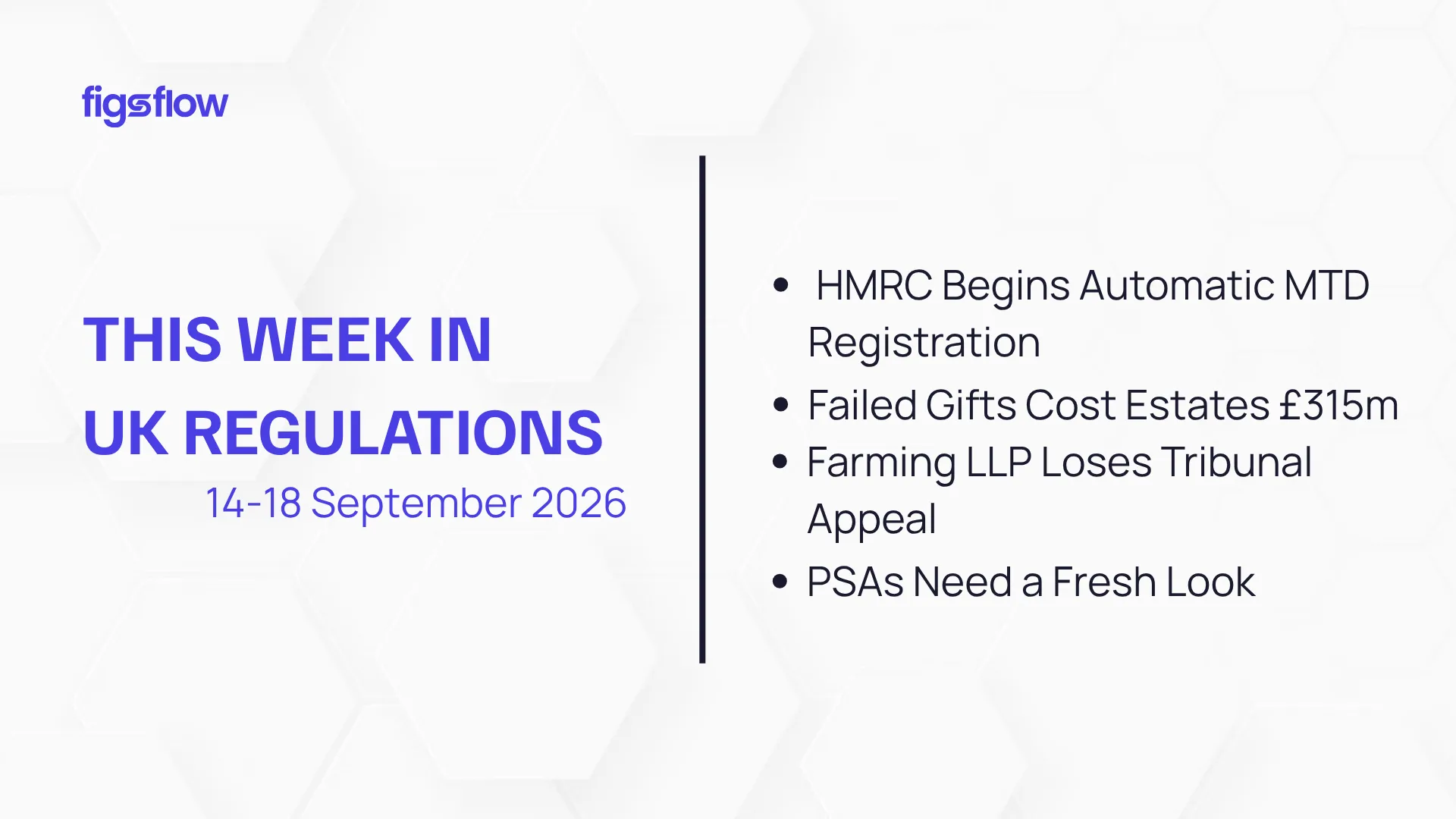
HMRC has begun automatically registering the remaining Making Tax Digital for Income Tax stragglers this month, and the next quarterly deadline on 7 November is closer than it looks for anyone still catching up. That is the story to act on first. Close behind it, employers relying on year-end P11D adjustments need to review their PAYE Settlement Agreements now, before mandatory payrolling of benefits removes that safety net.
The other two are about planning rather than panic. New figures show failed lifetime gifts are costing estates more each year, with taper relief still widely misunderstood, and a First-tier Tribunal ruling on sideways loss relief offers a useful precedent for any client claiming losses against other income.
Here is the detail.
HMRC Begins Automatic MTD Registration as Quarterly Deadlines Roll On
From September 2026, HMRC has started automatically registering taxpayers for Making Tax Digital for Income Tax where they earn £50,000 or more and have not signed up voluntarily or through an adviser. The campaign targets the roughly one third of that cohort still outside the regime, removing the choice of timing that some clients had been relying on.
The threshold does not stay fixed. It falls to £30,000 from 6 April 2027 and to £20,000 from April 2028, pulling an estimated two million taxpayers into scope over time. Clients sitting just above or below each threshold need to know which tax year brings them in, not just that MTD exists.
A new points-based penalty system starts in April 2027, with financial penalties from £200. A single missed quarterly update will not itself trigger a fine. It is the pattern of repeated misses that the system is designed to catch.
Key deadlines:
- 7 November 2026 - Second quarterly update due for the £50,000+ cohort
- 6 April 2027 - Threshold drops to £30,000
- April 2028 - Threshold drops to £20,000
Anyone with a client above £50,000 who has not registered should assume HMRC will do it for them, and check whether that client is ready for digital record keeping before it happens. For clients closer to £30,000, the conversation about April 2027 is worth having now.
Failed Gifts Cost Estates £315m as Taper Relief Confusion Persists
HMRC collected £315 million in inheritance tax on failed lifetime gifts in 2023-24, up from £256 million three years earlier. Freedom of Information data obtained by NFU Mutual shows more than 5,000 estates have paid over £1 billion on failed gifts since 2020, with the average tax bill on an affected estate now running at £226,000.
The confusion sits in how taper relief actually works. Surviving between three and seven years after a gift does not reduce the tax on that gift on a straightforward sliding scale. Any non-exempt gift made within seven years of death absorbs the £325,000 nil-rate band first, and taper relief only applies to tax due on whatever balance sits above that band.
A £100,000 gift followed by death six years later uses up part of the nil-rate band and generates no tax on the gift itself. A £425,000 gift in the same timeframe exhausts the band entirely, leaving £100,000 taxable at 40%, which taper relief then reduces by 80% to a final bill of £8,000. The size of the relief depends on how much of the gift sits above the nil-rate band, not on survival time alone.
Key facts:
- £315 million collected on failed gifts in 2023-24, up from £256 million in 2020-21
- Average tax bill on an affected estate: £226,000
- Autumn Budget due 28 October 2026, with gifts from normal expenditure out of income a possible target
With the Budget set for 28 October and Labour's manifesto ruling out increases to income tax, National Insurance and VAT, gifts from normal expenditure out of income are one of the reliefs advisers expect to come under scrutiny. Any client using that exemption for school fees or pension contributions should have their position reviewed before then.
Farming LLP Loses £1.6m Sideways Loss Relief Appeal Over Commerciality
The First-tier Tribunal has dismissed an appeal by former Formula 1 champion Jody Scheckter against an HMRC tax demand of £1,642,452, arising from sideways loss relief claimed through his Hampshire farming operation, Laverstoke Park Produce LLP. Scheckter had claimed £2,179,654 in losses against his other income and, in one year, against capital gains, across three tax years from 2007/08 to 2009/10.
HMRC opened its enquiry in January 2010 and did not issue closure notices until January 2019, denying the relief and fixing the amended liability. The tribunal accepted that Scheckter genuinely intended to make a profit from the venture, which grew from an organic farm into a diversified operation with buffalo, dairy and an abattoir. That intention was not enough. Judge Tony Beare found the trade was not carried on a commercial basis for the purposes of section 66(2)(a), and the claim failed on that ground alone.
Key facts:
- Amended tax liability: £1,642,452, against a claimed relief of £2,179,654
- Enquiry opened January 2010, closure notices issued January 2019
- Appeal dismissed on the section 66(2)(a) commerciality test alone
Subjective belief in eventual profit is not the test. Any client claiming sideways loss relief against other income needs to be able to show the trade was run commercially from the outset, not simply that they hoped it would turn a profit eventually.
PSAs Need a Fresh Look Before Mandatory Benefits Payrolling Lands
Mandatory payrolling of benefits in kind will remove a safety net that many employers currently rely on. Once benefits must be reported through payroll in real time, the option to correct omitted or misallocated items through a year-end P11D disappears. HMRC has also closed its Call for Evidence on PSA operational efficiency and is stepping back from its softer enforcement approach, according to Caroline Harwood, National Head of Employment Tax at BDO.
A PAYE Settlement Agreement lets an employer settle tax and Class 1B National Insurance on behalf of employees for items that are minor, irregular, or impractical to allocate individually, such as staff entertaining, long service awards or relocation costs above the tax-free limit. Agreements written for an older reward structure may no longer cover newer categories such as hybrid working costs or ad hoc recognition vouchers, leaving gaps that HMRC's tighter stance will start to notice.
Key deadlines:
- 5 July following the tax year end: deadline to agree or amend PSA terms
- 19 October: postal payment deadline
- 22 October: electronic payment deadline
Employers should map current benefits and expenses against their existing PSA categories now, rather than waiting for the payrolling rules to expose the gaps. Where a category has been described too narrowly, it is worth applying to HMRC to broaden it before real-time reporting removes the flexibility to fix it after the fact.
Also In The News
- Weekly News & Updates for UK Accountants (7-11 September 2026) - Last available round-up covering the stories that shaped that week for UK practitioners.
- What Comes After MTD - A roadmap of the MTD and tax adviser registration deadlines running from 2026 to 2028.
- Tax Adviser Registration with HMRC: What Has Changed & What You Need to Do - Background on the mandatory HMRC tax adviser register, relevant to the registration theme running through this week's MTD story.
Conclusion
The pattern this week is enforcement tightening on two fronts while the underlying rules stay largely the same. HMRC is now registering MTD clients automatically rather than waiting for them, and it is stepping back from soft-touch treatment of PSAs. Neither the taper relief rules nor the sideways loss relief test have changed, but the Scheckter case and the gifting figures show how easily both catch clients who assume the mechanics work differently to how they actually do.
For most practices the immediate work is narrow: check which clients above £50,000 have not yet registered for MTD, and get PSA categories reviewed before mandatory payrolling removes the year-end fix. The IHT and sideways loss relief points are worth raising in the next client review rather than acting on this week.
We publish these updates every week. Follow us to get next week's round-up as soon as it lands.
Run your firm on one platform
Proposals, engagement letters, pricing and AML — built for ACCA, ICAEW, ATT, CIOT, AAT and CIMA firms.