
Weekly News & Updates for UK Accountants (21-25 September 2026)
Is equalising CGT and Income Tax rates a good idea? Some experts don't think so. This and other news from the week in our weekly update today.
 Swikriti ThakuriSep 25, 2026Updated Sep 25, 2026
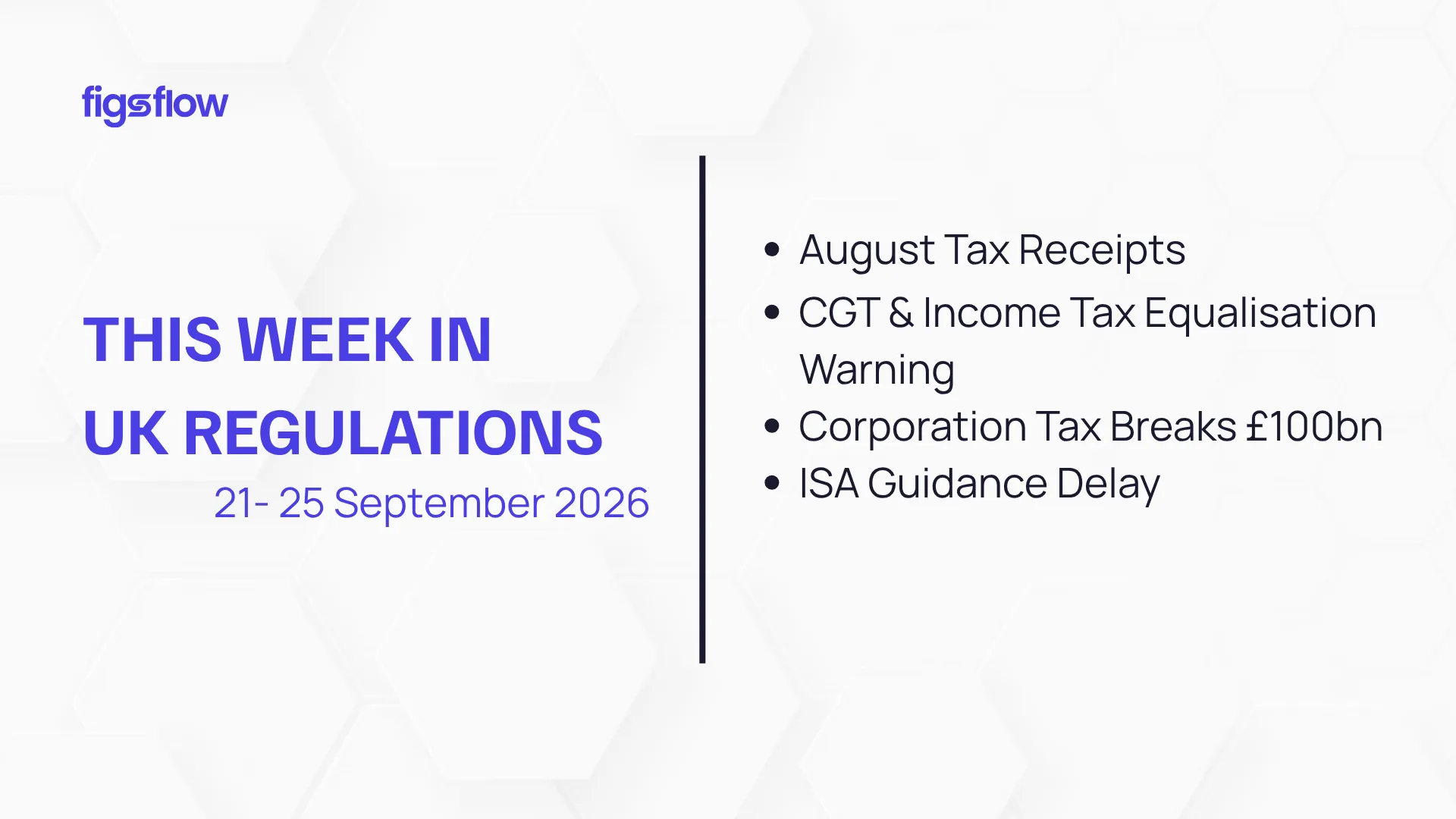
Ahead of the Autumn Budget on 28 October 2026, tax expert Ray McCann has warned against equalising capital gains tax with income tax rates, pointing to a 1988 reform that backfired badly. That is the story worth thinking through now, before any rates move. Close behind it, corporation tax receipts have broken £100bn for the first time, and BDO wants the Chancellor to use the milestone to simplify the rate structure altogether.
The thread running through the other two stories is the same date. Record tax receipts sit alongside a bigger than forecast borrowing figure, and HMRC's guidance on the new 22% tax on uninvested ISA cash is still unpublished, with advisers expecting it around Budget Day itself.
Here is the detail.
August Tax Receipts Hit £391.6bn as Borrowing Overshoots the OBR Forecast
HMRC collected £391.6bn in tax during the first five months of the 2026-27 tax year, up 6.8% (£25bn) on the same period last year. If the trend holds to year end, annual receipts could rise by £59bn.
Fiscal drag is doing much of the work: income tax receipts rose 7.8% to £141.9bn, employer NICs rose 10% to £64.5bn from last year's rate rise, and VAT receipts reached £76.8bn as inflation stays above target.
Capital Gains Tax barely moved: £198m in August against £194m in July. AJ Bell's Sarah Coles says tightening allowances aren't lifting revenue, because investors are simply deferring disposals, a detail that matters for the debate below.
Key facts:
- Five-month tax receipts: £391.6bn, up 6.8% (£25bn) year on year
- August borrowing: £18.3bn against the OBR's £14.8bn forecast, with debt at 93.8% of GDP
- Income tax receipts up 7.8% to £141.9bn, driven by frozen thresholds
Tom Goddard at Blick Rothenberg notes that spending growth, driven by inflation and fuel costs from the conflicts in Ukraine and Iran, is outpacing tax growth, the backdrop the Chancellor takes into the Budget.
Expert Warns Equalising CGT & Income Tax Rates Risks Repeating the 1988 Collapse
Ray McCann CTA (Fellow) ATT, a former HMRC assistant director of more than 30 years and a past CIOT president, has cautioned against a move some expect at the 28 October Budget: bringing capital gains tax rates into line with income tax. His warning rests on a precedent that has already played out badly once.
In 1988, then-Chancellor Lord Lawson aligned CGT with income tax rates on the view that gains and income were economically the same, but indexation relief and the 1982 asset rebasing were both still in place, and corporate CGT yields collapsed. The Inland Revenue had also misjudged the effect on avoidance and staffed its tax inspectorate accordingly, a miscalculation that took years to unwind.
Asset owners responded to the higher headline rate by holding rather than selling, an effect known as asset locking, and revenues kept falling for well over a decade afterwards.
Key facts:
- 1988: CGT aligned with income tax rates while indexation relief and 1982 asset rebasing remain in place, and corporate CGT yields collapse
- 1998: indexation relief ends for individuals and trusts, but CGT revenues keep falling regardless
- By 2003: Treasury and Revenue officials are seriously discussing whether to abolish CGT altogether
McCann distinguishes risk from income: some short-term gains behave like ordinary income, but most capital gains reflect years of ownership and real capital risk. Equalising the rates without the protections that existed in 1988 risks the same collapse in receipts. For clients weighing a disposal, this is worth raising before 28 October, not after.
Corporation Tax Receipts Break £100bn as BDO Calls for a Single 21% Rate
Annual corporation tax receipts reached £100.4bn in 2025-26, breaking the £100bn mark for the first time, though growth has slowed to a 4% (£3.5bn) rise on 2024-25's £96.9bn.
The trend line shows the deceleration clearly: receipts stood at £42.4bn a decade ago and £59.9bn before the pandemic, rising to £84.5bn just before the main rate increased to 25% in April 2023. HMRC has acknowledged that the rate rise itself has produced diminishing returns against weak wider economic growth.
Key facts:
- Total CT receipts: £100.4bn in 2025-26, up 4% (£3.5bn) on 2024-25
- Financial and insurance sector: 27% (£25.3bn) of total receipts, up 17% year on year
- Small Profits Rate (19% on profits under £50,000): raised £2.92bn
Jonathan Hickman at BDO argues that the current three-tier structure adds administrative complexity without a matching benefit. BDO wants Chancellor John Healey to phase in a single 21% rate instead, below the EU average. Worth flagging to owner-managed company clients in the marginal relief band, since a flat rate would remove that calculation entirely.
HMRC Delays Guidance on the New 22% Tax for Uninvested ISA Cash
From 6 April 2027, the reformed ISA regime takes effect, bringing a flat 22% tax on interest earned on cash left uninvested inside Stocks & Shares ISAs and Innovative Finance ISAs, alongside a reduced Cash ISA subscription limit for younger savers.
Higher and additional rate taxpayers will not pay a higher rate on this interest, and providers will calculate and remit the tax directly to HMRC, so savers should not need to report it via Self Assessment.
The guidance confirming this is not out yet. HMRC told Business & Accountancy Daily that updated ISA Manager Guidance on gov.uk remains unpublished, promising release “as soon as possible,” with the industry now expecting it around Budget Day. Advisers want written confirmation that clients carry zero personal liability for uncollected tax on uninvested balances, and HMRC's 23 June update did not address that point.
Key facts:
- Effective date: 6 April 2027 (tax year 2027-28)
- Flat rate: 22% on uninvested cash interest, deducted automatically by providers
- Cash ISA subscription limit: capped at £12,000 for savers under 65
Flag this to any client holding a Stocks & Shares or Innovative Finance ISA with a meaningful uninvested cash balance, and watch for the guidance around Budget Day so the liability position can be confirmed in writing.
Also In The News
- Weekly News & Updates for UK Accountants (14-18 September 2026) - Last available round-up covering the stories that shaped that week for UK practitioners.
- What Comes After MTD - A roadmap of the MTD and tax adviser registration deadlines running from 2026 to 2028.
- Tax Adviser Registration with HMRC: What Has Changed & What You Need to Do - Background on the mandatory HMRC tax adviser register.
Conclusion
The pattern this week is a Treasury collecting more than ever while still borrowing more than planned, heading into a Budget where every option on the table has a documented precedent for going wrong. McCann's 1988 warning and the still-unpublished ISA guidance are two versions of the same problem: policy that looks straightforward in a headline rarely stays that way once it meets client behaviour.
Nothing here carries a deadline this week. The near-term work is watching, not filing: flag the CGT rate speculation to clients weighing a disposal before 28 October, and check for the ISA Manager Guidance expected around Budget Day. The corporation tax proposal and the wider fiscal picture are context for now, worth having ready when clients ask what the Budget might bring.
We publish these updates every week. Follow us to get next week's round-up as soon as it lands.