
No Photo ID? What You Can Use in the UK
No passport or driving licence? Every ID you can use instead in the UK — for banks, work and voting — with costs, timings and the free option. Updated Sept 2026.

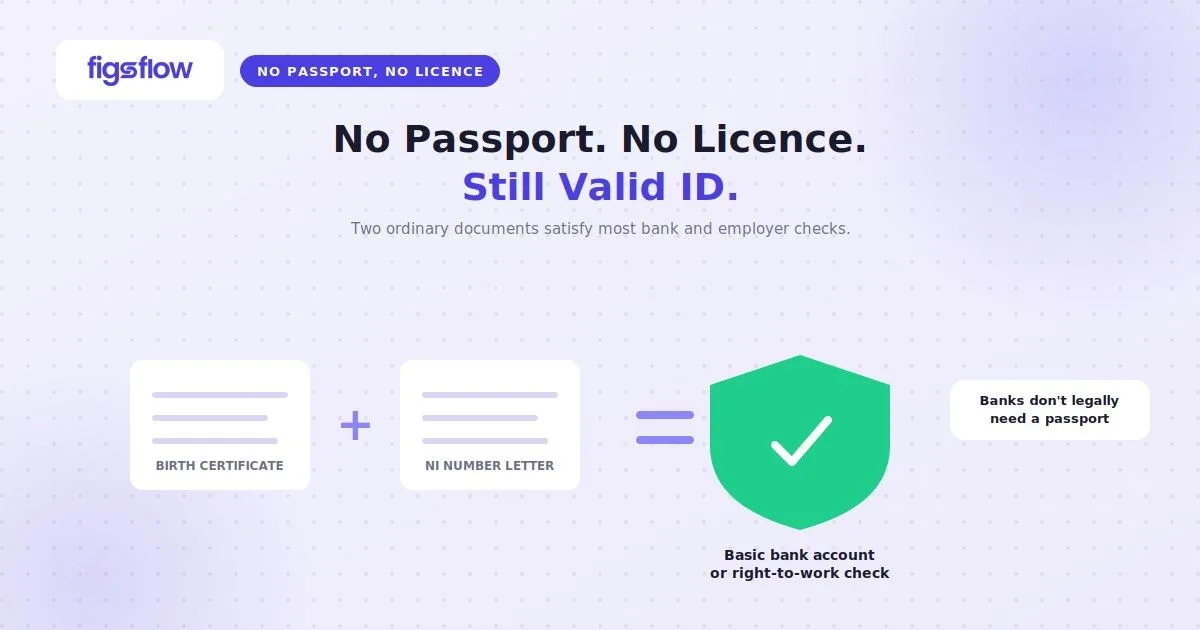
No photo ID? This guide sets out every document you can use instead in the UK — for opening a bank account, starting a job, voting, and official identity checks — with what each one costs and how long it takes to get.
A form asks for photo ID. You run through the options: no passport, you don’t drive, and no provisional licence either.
What now? Millions of UK adults have neither a passport nor a driving licence, so if that is you, you are not unusual and you are not stuck. There is a free route, a £34 route, and a set of two-document combinations that banks and employers accept every day.
This guide covers all of them: what counts as photo ID in the UK, how to get one quickly, what to do when you need a bank account today, and which documents will not work no matter who is asking.
What counts as photo ID in the UK?
There is no single national list. Each organisation sets its own, which is why a document your bank refuses can be perfectly acceptable at a polling station. But almost every list in the UK is built from the same pool:
- UK passport — the document most lists treat as the gold standard
- UK photocard driving licence, full or provisional
- PASS-accredited proof-of-age card, such as a CitizenCard
- Biometric residence permit
- National identity card issued by an EU or EEA country
- Defence Identity Card (MOD Form 90) or HM Armed Forces Veteran Card (MOD Form 100)
- Voter Authority Certificate or Anonymous Elector’s Document — for voting only
- Older person’s or disabled person’s bus pass, Blue Badge, Oyster 60+ card, Freedom Pass, Scottish National Entitlement Card — accepted for voting, rarely elsewhere
Two things trip people up. First, a document can be photo ID for one purpose and worthless for another — a bus pass will get you a ballot paper but will not open a bank account. Second, a document does not have to carry your photograph to prove who you are. Banks and employers routinely accept combinations of non-photo documents, which is the route most people without a passport actually end up taking.
If you have no photo ID in the UK, you can use these instead
Here is every realistic option side by side, with what it costs, how long it takes, and — the part most guides leave out — what it is actually accepted for.
| Option | Cost | How long | Accepted for | Do you need photo ID to apply? |
|---|---|---|---|---|
| Voter Authority Certificate | Free | About 2 weeks | Voting in person only | No |
| PASS-accredited card (e.g. CitizenCard) | Around £15–£18 | Around 3 weeks | Age checks, voting, many everyday identity checks | No — a countersignature from someone who has known you 2 years is used instead |
| Provisional driving licence | £34 online, £43 by post | About 1 week online | Banking, employment, voting, age checks — the most widely accepted of the cheap options | Online route may ask for a passport. Use the postal D1 form if you have none |
| UK passport | £102 online, £115.50 by paper form | Weeks; urgent services cost more | Everything, including travel | No, but you need a countersignatory and supporting documents |
| Birth certificate + National Insurance document | About £12.50 for a replacement certificate | Days to weeks | Banking and right-to-work checks. Not age checks | No |
| Solicitor-certified ID1 form | Typically £20–£100 | One appointment | Property and Land Registry matters, and organisations that insist on certified identity | No — the solicitor verifies you in person |
How to get photo ID fast, and how to get it free
There is no same-day photo ID in the UK. Nothing is issued over a counter while you wait, so if a deadline is coming, the order you apply in matters more than which document you pick.
Fastest: a provisional driving licence. GOV.UK says the licence should arrive within a week of applying online, which makes it the quickest route to a government-issued photo ID that banks and employers will accept without argument.
Free: a Voter Authority Certificate. It costs nothing, you apply on GOV.UK or through your council, and it takes roughly two weeks. Be clear about its limits, though — it exists so that people without photo ID can still vote. It is not a general-purpose identity card and most banks and employers will not take it.
If you hold no photo ID whatsoever, this is the detail that matters: the online provisional licence application can ask for a passport to verify who you are. If you do not have one, apply on form D1 instead, which you can pick up at a Post Office and post to DVLA with a passport-style photograph. The postal route costs £43 rather than £34 and takes longer, but it does not assume you already own the thing you are trying to obtain.
If the deadline is a job start date, do not wait for a card at all. A UK birth certificate plus a document showing your National Insurance number can satisfy a right-to-work check now, and you can apply for photo ID in parallel.
If the deadline is an election, check the accepted list before spending anything. Expired ID still counts for voting, as do several travel passes — there is a good chance you already hold something that works.
What if you need to verify your identity for Companies House?
If you are a company director or a person with significant control, you have a separate obligation that none of the documents above will settle on their own. Under the Economic Crime and Corporate Transparency Act, Companies House now requires directors and registrable PSCs to verify their identity, with the deadline for directors tied to the company’s next confirmation statement date.
This is a different regime from the checks a bank or an employer runs. Those are risk-based — a bank can weigh up a combination of documents and decide it is satisfied. Companies House verification is fixed: the same standard applies to everyone, and it is met or it is not.
There are two routes. You can verify yourself directly through GOV.UK One Login, which works by scanning a photo ID document with your phone — so it is the route that fails if you have none. Or an Authorised Corporate Service Provider can verify you and confirm it to Companies House on your behalf. An ACSP examines your documents rather than relying on an app reading a chip that isn’t there, which makes it the more practical route if you have no photocard. Either way the check is done once: the personal code you receive covers every directorship and PSC role you hold, across every company.
If that applies to you, two guides go further: who has to verify, when each deadline falls and how the personal code works, and what verification through an ACSP involves.
Your three best alternatives to photo ID in the UK
PASS-accredited card (around £15 to £18)
PASS is not a card. It is the national Proof of Age Standards Scheme, and the PASS hologram is an accreditation carried by cards from approved issuers — CitizenCard being the best known. That distinction matters when you are searching, because there is no single “PASS card” to buy; you apply to an issuer and the card arrives carrying the hologram.
Expect to pay around £15 to £18 and to wait roughly three weeks. You will need a digital photograph, your details, and someone who has known you for at least two years to countersign your application — a family member, a friend, or a professional. That countersignature is the point: it is how the scheme verifies people who have no photo ID to begin with.
A PASS card is on the accepted list for voting in person and is widely taken for age checks. Beyond that, acceptance varies by organisation, so if you need it for a specific bank or employer, ask them first rather than assuming.
Provisional driving licence (£34 online, £43 by post)
Even if you never intend to drive, this is the cheapest government-issued photo ID in the UK, and it is the one that causes the fewest arguments. A photocard provisional licence does everything a full licence does for identity purposes: banking, employment checks, voting, age-restricted purchases.
Apply on GOV.UK with your National Insurance number, your addresses for the last three years and a digital photograph. You must be at least 15 years and 9 months old and have the right to live in Great Britain for at least 185 days. GOV.UK states the licence should arrive within a week of an online application, though DVLA may take longer if it needs extra checks.
The catch, again: the online route may ask for a passport so DVLA can verify your identity electronically. With no passport, use form D1 by post.
Voter Authority Certificate (free)
A Voter Authority Certificate is a free paper document showing your photograph, name and date of birth. It was created for one purpose: so that voter ID rules do not stop people without a passport or driving licence from voting. Apply on GOV.UK or through your local council with a recent digital photo and your electoral registration details. Allow about two weeks.
Be realistic about what it does. It is on the accepted list at polling stations and it is genuinely free, which makes it worth having. It is not a substitute for a bank’s or an employer’s photo ID requirement, and you should not plan a bank application around it. If you need identity proof for anything other than voting, the provisional licence or a PASS card is the document to pursue.
If you have no fixed address, you can still get one. Register to vote using the address where you sleep most nights, or make a declaration of local connection, and apply for the certificate using those registration details.
Can you open a bank account without photo ID in the UK?
Yes. It is harder than walking in with a passport, and some branches will tell you it is impossible, but it is done every day and the rules are on your side more than the conversation at the counter suggests.
Do banks legally need to see photo ID?
No. This is the most useful thing to understand before you apply.
Under the Money Laundering Regulations 2017, a bank must verify your identity using information from a reliable source independent of you. It does not say passport. It does not say driving licence. Those two documents are simply the fastest way for a bank to satisfy the rule, so they became the default request — and then the default assumption.
Banks are also expected not to shut people out of banking because they lack the standard documents. That is why every major UK bank has a documented process for customers with non-standard identification, even where front-line staff are not familiar with it. If the first person you speak to says no, the phrase that opens the door is: “I don’t have photo ID — can I speak to someone about opening a basic bank account, and can you tell me what alternative documents you accept?”
Basic bank accounts: what they are and who can get one
A basic bank account is a stripped-back current account: it takes payments in, pays bills by direct debit, gives you a debit card, and does not offer an overdraft. Every major UK bank and building society offers one, and they are designed for exactly the situations that make a standard account difficult — no credit history, a poor credit record, past bankruptcy, no fixed address, or no standard identification.
They are the right product to ask for by name. A basic bank account application is assessed differently from a standard current account, and the identification requirements are usually applied with more flexibility.
Can you open a basic bank account online without ID?
Usually not in one sitting. App-based banks onboard entirely online, but the flow is built around photographing a photo ID document and matching your live face to it — so with no photocard at all it fails at the identity step. High-street banks let you start online and finish in a branch or by post, where a person can review a combination of non-photo documents instead. If you want the fully online route, get a provisional licence first.
What documents to take to the bank
A bank needs two things: proof of who you are, and proof of where you live. Take as much as you can from each column — more documents make a manual check easier to approve.
| Proof of identity (no photo needed) | Proof of address (dated within 3 months) |
|---|---|
| Birth certificate — original, not a photocopy | Utility bill: gas, electricity or water |
| Adoption certificate or marriage certificate | Council tax bill |
| Document showing your National Insurance number: NI card, P45, P60, or a letter from HMRC | Bank or building society statement from another provider |
| Benefit award letter from DWP or HMRC — State Pension, Universal Credit, Child Benefit, tax credits | Tenancy agreement or housing association letter |
| Letter from a hostel, support worker or registered charity confirming who you are | Letter from your GP surgery showing your registered address |
| NHS medical card showing your NHS number | Letter from a school, college or university if you are a student |
| Solicitor-certified ID1 form | Letter from your local council, including its homelessness service |
Opening a bank account with no fixed address
Having no permanent address does not disqualify you. What replaces a utility bill is a letter on letterhead from an organisation that knows you — a hostel or night shelter, a support worker or case worker, or a homelessness charity such as Shelter, Crisis or The Salvation Army. Some banks will accept that organisation’s address for correspondence. If you are refused, ask for the reason in writing and try another provider: document policies genuinely differ between banks.
Can you use a birth certificate as ID in the UK?
On its own, no. As one half of a pair, very often yes.
The reason is simple once you see it. A birth certificate proves that a person with that name was born on that date. It carries no photograph and no signature, so it cannot prove that you are that person. That is why almost no organisation accepts it alone, and why it is powerful the moment you pair it with something that links the name to you.
What a birth certificate can do:
- Paired with a document showing your National Insurance number, satisfy a right-to-work check
- Paired with proof of address, open a basic bank account
- Support an application for a passport or a provisional driving licence
What it cannot do:
- Prove your age to buy alcohol or enter an age-restricted venue — no photo, no match
- Get you through an airport
- Stand as sole identity proof where a witnessed signature is required
The three-document version. If a bank or employer is hesitating, add a third document. A birth certificate, plus National Insurance evidence, plus a recent utility bill or council tax bill is a strong combination that clears most manual checks. An NHS medical card and government correspondence strengthen it further. Recency matters — anything within the last three months carries the most weight.
One practical note: bring the original. Lost yours? A replacement from the General Register Office costs about £12.50 and is worth ordering early, because it is the document most of the alternatives in this guide are built on.
Can you use a photo or photocopy of your ID?
Almost never, and it is one of the most common reasons an application gets rejected.
A photograph of your passport on your phone, a scan, a screenshot, or a photocopy you made yourself all fail for the same reason: none of them can be examined for the security features that prove the document is real. Holograms, machine-readable zones and the feel of the material are what a checker is looking at, and a copy destroys all of it.
There are two exceptions worth knowing:
- A certified copy. A solicitor, notary or other designated official can examine your original, take a copy, and certify in writing that it is a true likeness. That certified copy is accepted in many situations where the original cannot be sent. Certifying usually costs a small fee.
- A regulated digital identity check. Where an organisation uses a certified identity service provider, you may be asked to upload a photograph of your document and record a short video selfie. That looks like “sending a photo of my ID” but it is not — the software is checking the document’s embedded chip or security features and matching your live face to it. It only works through that provider’s own app or portal, never by emailing a picture to someone.
So: never email or hand over a photo of your ID and expect it to be accepted, and be wary of anyone who asks you to. Send a certified copy, or complete the check through the organisation’s own verification process.
Is there a UK national identity card?
No. The UK has no compulsory national identity card and no general-purpose personal ID card that every citizen holds. Wartime identity cards were abolished in 1952, and the ID card scheme introduced under the Identity Cards Act 2006 was cancelled in 2010, with the cards issued under it withdrawn from use.
That absence is precisely why this question is so common. In most European countries the answer to “I have no passport” is “use your national ID card”. In the UK there is no such fallback, so identity is proved with a patchwork of documents issued for other purposes — a driving licence for driving, a bus pass for travel, a proof-of-age card for buying alcohol.
The closest things to a general personal ID card available today are the ones in this guide: a PASS-accredited card, or a provisional driving licence if you want something government-issued. Proposals for a national or digital ID scheme surface regularly in political debate, but nothing has replaced the patchwork, so plan around the documents that exist now.
What ID can you use to vote without photo ID?
Voting has the most generous accepted list of any UK identity check, and two features of it save people money. Expired ID is still accepted, and several travel and concession passes count — so check what you already hold before paying for anything. Alongside a passport or photocard driving licence, the list includes a PASS card, Blue Badge, biometric residence permit, Defence Identity Card, HM Armed Forces Veteran Card, EU or EEA national identity card, Northern Ireland Electoral Identity Card, an older person’s or disabled person’s bus pass, Oyster 60+ card, Freedom Pass, Scottish National Entitlement Card, Welsh concessionary travel card, and the Voter Authority Certificate or Anonymous Elector’s Document. If none applies, apply for the free certificate before the deadline, which falls several days before polling day — or use a postal vote, which needs no photo ID at all.
How to prove your identity for work without photo ID
A right-to-work check has to establish who you are and that you are allowed to work in the UK. For a British or Irish citizen with no passport, the standard route is a two-document combination, and an employer is expected to accept it — refusing to consider anything but a passport is not what the Home Office guidance requires.
The pairing is a UK birth or adoption certificate together with an official document showing your National Insurance number. The certificate must have been issued in the UK, the Channel Islands or the Isle of Man, and there are conditions attached to older certificates, so confirm the current position with your employer or on GOV.UK before relying on it.
What counts as National Insurance evidence:
- Your plastic National Insurance card, if you still have one — they were discontinued but existing cards remain valid
- A P45 from a previous employer showing your NI number
- A P60 end-of-year certificate from any past employer
- A letter from HMRC or DWP showing your National Insurance number
- Payslips showing your NI number — accepted at some employers’ discretion, though not formally listed
If a role is starting soon, this is the fastest route available to you. It needs no application, no fee and no waiting for a card in the post.
The ID1 form: solicitor-certified identity
An ID1 is a certificate of identity completed and signed by a solicitor after they have verified you in person. It records your name, date of birth, address and physical description, and it carries the solicitor’s stamp and signature. It exists mainly for HM Land Registry, which needs identity confirmed for property transactions, but it is useful anywhere an organisation insists on certified identity and you have nothing photographic to offer.
What you need to take:
- Two proofs of residency dated within the last three months — utility bills, bank statements or council tax bills
- One passport-sized photograph taken within the last six months
The solicitor interviews you, examines the documents, and completes the form. Cost varies considerably by firm, typically £20 to £100. Before you pay, ask your local Citizens Advice and your council — some offer certification free or at reduced cost to people on benefits, and it is worth ten minutes to check.
Treat this as the route you take when the cheaper options have not worked, rather than the first thing you try. For most people a £34 provisional licence solves more problems for less money.
What if you're homeless or have no fixed address?
Proving who you are is harder without stable housing, but every one of the three main routes — banking, employment and voting — has a specific provision for it.
For employment
A letter on official letterhead from a hostel manager confirming your residency, documentation from an organisation supporting you — probation services, social services, a housing charity — or correspondence from your local council’s homelessness department all help establish address. Your birth certificate plus National Insurance documentation still works for the identity half regardless of your housing situation.
For registering to vote
Register using the address where you sleep most nights — a hostel, a shelter, a friend’s sofa — or make a declaration of local connection if you have no address at all. Once registered, you can apply for a free Voter Authority Certificate using those details.
Documents that don't count as ID in the UK
Knowing what will be refused saves a wasted trip. These are the documents people most often bring in good faith and get turned away for.
Student ID cards. A university or college card proves you are enrolled, not who you are. No government body stands behind it and it is easy to forge. Fine for a student bar, never for banking, employment or legal identification.
Work ID badges. An employee card from a private company has no standardised security features and no official backing. It carries weight only inside the company that issued it.
Old paper provisional licences. Paper licences without a photograph stopped working as identification years ago. If that is what you hold, apply for a photocard provisional licence instead.
Mobile phone bills. Most organisations refuse these as proof of address because they are easy to fabricate, and pay-as-you-go bills prove nothing about where you live. Where a contract bill is accepted it is only ever as address evidence, never as proof of identity.
Expired documents — with one big exception. An expired photocard licence, passport or biometric residence permit is not current proof of identity for a bank or an employer, though some will accept one that expired recently alongside other documents. Voting is the exception: expired ID is explicitly accepted at polling stations, so do not throw away an old passport before an election.
Foreign documents. A foreign birth certificate, foreign driving licence or overseas ID card works only in specific circumstances, usually with certified translation. For everyday UK identity checks, UK-issued documents carry the most weight.
The pattern behind all of it: identity checks want documents that are recent, original, and either government-issued or professionally certified. Personal documents, company-issued cards and copies do not meet that bar.
Why you are being asked for ID at all
It helps to know what is happening on the other side of the counter, because it explains why document combinations work when a single document does not.
Banks, accountants, solicitors, estate agents and letting agents are all regulated for anti-money laundering purposes. Before they can act for you, the Money Laundering Regulations 2017 require them to carry out Customer Due Diligence — to identify you, and to verify that identity using information from a reliable source independent of you. That is the whole obligation, and it is why the rule is satisfied by a birth certificate plus HMRC correspondence just as it can be by a passport. Nothing in the regulations names a document.
Two practical consequences follow. First, when a firm insists on a passport, that is their internal policy rather than the law, and it is reasonable to ask what alternative evidence they accept. Second, a firm cannot simply waive the check to be helpful — the obligation is on them, with real penalties attached, which is why they will keep asking until they have something they can evidence and retain.
If you are the firm doing the checking, that is a different problem from this one: you need to accept a wide range of documents, judge risk, and keep an auditable record of every decision. Start with the acceptable documents list for CDD, then how AML verification works in practice, and how FigsFlow handles identity verification, screening and the audit trail in one workflow.
Useful links
- Apply for your first provisional driving licence, including the postal D1 route: GOV.UK — Apply for your first provisional driving licence
- The full accepted photo ID list for voting: GOV.UK — Photo ID you’ll need to vote
- Apply for the free Voter Authority Certificate: GOV.UK — Apply for photo ID to vote
- Current passport fees and urgent services: GOV.UK — Passport fees
- Order a replacement birth certificate: GOV.UK — Order a copy of a birth certificate
Conclusion
If you have no photo ID in the UK, pick your route by what the deadline actually is. Photo ID that works everywhere: a provisional driving licence, £34 online and about a week in the post, or £43 by post on form D1 if you hold nothing photographic to apply with. Cheaper: a PASS-accredited card, around £15 to £18. Voting only: the Voter Authority Certificate is free — and check the accepted list first, because an expired passport or a bus pass may already be enough.
Need a bank account or a job now? Don’t wait for a card. A birth certificate paired with a document showing your National Insurance number, plus recent proof of address, is what banks and employers actually work from — and a basic bank account is the product to ask for by name.
Millions of UK adults manage without a passport or a driving licence. There is a route through for every one of these situations — pick the one that fits your timeline and your budget.